Martin2001 Antique Prints
| Contact Me
|
Selling 18th to 20th Century original
antique prints,
offering a great variety of
subjects,
and Satisfaction
Guaranteed
service.
Terminology
Page
A
| B-C
| D | E |
F-G-H
| I-J-L | M-N
| O-P
| R-S | T-V-W
| X-Z
|
Note: The present tense in the definitions
(e.g. "Machines are
largely used in modern engraving ...")
refer to the time period of the 19th Century not the 'current'
present.
General
Notes
associated with our prints
|
© Martin2001.com 1998 - 2025
1 - Engraving: The
terms Steel Engraving, Wood Engraving, Photogravure,
Typogravure, Lithograph,
Etching, Heliogravure, etc. refer to a PRINTED
PIECE OF PAPER. In this sense, these technical terms have
been in standard
use since the 19th Century to distinguish between various
types of illustrations
and pictures printed on paper. They DO NOT denote a piece of
the steel
plate (or woodblock) from which they were printed. The
pictures below illustrate
a typical overall view of two most frequent types of prints.
(See
individual entries for examples of other types).
|

Typical
view of a steel
engraving.
It is usually printed on medium or
heavier wove (rougher surface) paper.
Typical
view of a wood
engraving.
It is usually printed on
medium heavy, coated (smoother surface) paper.
|

|
2 - Whiteness of Paper:
ALL
PRINTS THAT I OFFER ARE VINTAGE 19TH CENTURY PRINTS,i.e.
they are NOT
modern reproductions. Both, the paper and the printing ink are
of the date
indicated in the title box of each auction. The whiteness of
paper, or
the lack of brownish toning and spots, does not mean that the
print is
modern. Many engravings (especially German and French from
that period)
were printed on very high quality printing paper (better than
many modern
brands) and they keep their whiteness and freshness. Many
prints were improperly
stored and they developed various forms of stains, spots,
brownish toning,
etc. Restoration conservation methods are used to clean and
conserve them.
These conservation procedures prevent the formation of such
spots and future
deterioration and give them the look they had when they came
off the press
so many years ago. A number of the prints we sell have been
professionally
cleaned.
3 - Plate Marks: Not
all steel or copperplate engravings have the metal plate
impressions
called plate marks (see 'Plate
mark'). These were prevalent
in the early stages of making steel
(copper-plate) engravings, until approximately 1850s, when the
steel
printing
plate was smaller than the actual piece of paper onto which it
was
printed.
As the images became larger, the steel plates became
larger than
the actual pieces of paper so the edges of the plate would
fall outside
the printing paper. The majority of the 1860s-1890s engravings
thus do
not show any impression marks at all. Also, in order to
increase
the efficiency of the printing process, several engravings
were often
engraved
onto a single plate and the impression marks were trimmed off.
JUST AS
THE PRESENCE OF A PLATE MARK DOES NOT GUARANTEE THE
ORIGINALITY OF A
STEEL
ENGRAVING (see False Intaglio below), THE ABSENCE OF A PLATE
MARK DOES
NOT MEAN THAT THE ENGRAVING IS NOT AN ORIGINAL.
More in regard to Plate
Marks:
The plate mark is a natural result of intaglio printing. When
the (dampened
sheet of paper has been laid on the inked copper plate, and
the two are
together subjected to pressure on passing through the press,
the paper
is squashed with great force against and around the plate. The
edge of
the plate, beveled to prevent its cutting into the paper, will
leave a
clear mark in the paper; and, less noticeably, the surface of
the plate
will flatten the fibers of the paper, leaving them smoother
within the
plate mark than outside it. The copper plate is usually
rectangular, but
it need not be so.
In the majority of cases
the presence
of a plate mark shows that the print has been made by an
intaglio process.
This is true even where the image is on a separate sheet of
India paper,
mounted within the plate mark impressed on the heavier paper.
However,
it is easy to create a false plate mark - either by passing a
smooth copper
plate through the press with a sheet of paper on which the
image has already
been printed by other means, or by mechanically blocking
it
- giving the deliberately misleading impression
that
it is a hand-crafted intaglio print rather than a
process print.
Usually the false plate mark will look too perfect - too
regular in its
edges and angles, too smooth, too clean. A revealing place to
look is where
the bevel of the plate comes. In the messy business of wiping
and printing
a genuine intaglio plate, small traces of ink are often
overlooked on these
beveled edges; they will then show up as occasional dark spots
or smudges
at the extremities of the plate mark, particularly in the
corners. By contrast
the blocking of a false plate mark has been done in a machine
far removed
from inky matters, and there will be no such impurities.
Something resembling
a plate mark can often be seen on prints bound into books and
provided
with protective tissues. The tissue is usually larger than the
printed
area but smaller than the page, with the result that after
years of pressure
in the bookshelf it may cause a rectangular indentation in the
paper which
will look very like a plate mark.
A plate mark will not
necessarily
be false if a different sheet of paper is securely glued within
it,
but it is certain to be false if the inner sheet is only tipped
in
loosely
at the corners. As mentioned above the presence of a plate mark
does not guarantee
an intaglio print, so the absence of a plate mark does not prove
the
opposite.
The print may have been issued in the normal way with a plate
mark, but
a binder or framer may have trimmed it. Smaller intaglio prints
were
often
printed several on a plate, requiring one working of the press
for the
set
instead of one for each. The plate mark would then come outside
the
entire
group. If they were intended to be cut up and sold separately,
or used
as book illustrations, each would from the start have lacked a
plate
mark
though being a normal intaglio print. There are two
circumstances in
which
lithographs can show an impression mark similar to an intaglio
plate
mark.
The printer may not have changed his scraper to fit a smaller
size of
stone, with the result that the paper is pressed down round the
edges
of
the stone. Or the artist may have drawn his image close to the
edges of
the stone, making the wider scraper a necessity and providing an
impression
mark just outside or even coinciding with the image. In either
case the
edges of the impressed area may show one characteristic
different
from an intaglio plate mark,
having small
irregularities along their length which result from chips in the
stone.
By contrast the copper plate is likely to have a perfectly
straight
edge,
providing a regular and unbroken line in the plate mark. [Source:
an
older book on prints, no title available]
4 - Identification of
prints & determination of age:
Identification
of prints requires certain tools, the knowledge of the
printing
processes and also some experience.
First impressions about a print in question are almost always
incorrect
(e.g. "it is just a bad xerox copy," "it does
not look old to me at all," etc.) In order to make a
knowledgeable
decision
about the age, type, method of printing, etc. of the print,
one needs
to
make a careful examination of paper, type of printing, etc.
using
a strong magnifying glass (at least 4x to 10x), a light table,
and a
black light. An
examination of old paper will reveal many imperfections that
are not
present
in modern papers, a comparison examination with the black
light may
reveal
additives in the new paper not present in the old paper. Looking
through the print against
the
light (or over the light table) may reveal minute spots,
blemishes, small pieces of pulp or other imperfections not
immediately apparent;
again, such imperfections would not be present in modern
paper, e.g.
take a sheet of common xerox paper and the print and look at
then
against a source of light. Even the cheapest xerox paper
doesn't have
little specks and imperfections that you can see in the old
print.
In the intaglio printing
process the dampened paper is usually fed against a very
smooth metal
plate (covered by a blanket) so when pressed by rolling press
the
dampened paper is squeezed into the plate's ink-filled grooves
with
uniform very high pressure. As a result, the printing
side of the
paper of often much smoother then the reverse side. That's
another sign
of a genuine antique print.
Another useful examination
is
for coated paper (used for wood engravings). As these were
mostly bound
into various folios, art magazines etc, their three edges were
exposed
to the light (the edge where the binding occurs was not
exposed to the
light) thus causing light darkening of the paper over time.
Place such
a sheet of paper on the light table and examine the edges. If
you see
slight darkening of the tone it is a definite sign that the
paper is
old as modern papers do not exhibit such a phenomenon which
takes
dozens of years to develop.
The presence of a watermark
or other patterns would also indicate that
the print is old. Some prints have a rugged edge, indicating a
removal
from an antique bound volume that was stitched
together, a method of binding not used anymore.
If there are holes from the stitching, this would also
indicate an
antique
print. Examine the edges of the print and try
to discern the residue of either marbled or gilded edges.
These would
again
indicate that the print is antique and not a modern
reproduction. If
gently rubbing the darker area of the print (if it is an
intaglio
print) with the tip of the finger leaves some printing ink
residue on
your finger, it is another sign that the print is original.
None of the modern
reproduction techniques is able to reproduce the fine lines of
the
intaglio process; that's why our paper money is still printed
using
this process and not various modern, and very sophisticated
reproduction printing techniques. For example, in the case of
the
steel engraving (=intaglio), find a strong dark line and
examine it
through a
strong magnifying glass. Does the ink seem to raise up from
the paper,
somewhat like a rust? (the red triangle on the sketch below).
If so,
this is one of the main
characteristics of the intaglio process and it indicates that
the
printing is original. (Any reproduction's surface would be
smooth).
However, this effect may not be always strong and
very discernible, if the print was printed from a worn out
steel plate;
after a number of impressions, the surface of the plate gets
worn-out,
the engraved lines in the plate start
to deteriorate and become shallower and deposit less ink on
the paper
during the printing process. As a result, many prints that
were printed
from such worn-out plates look less 'contrasty' and may lead
one to
believe that they are modern reproduction. There
are many other examination steps that need to be taken and
questions
answered before a
knowledgeable decision can be made. So if you are really
interested in
finding out more about your print, never rely on your first
impression
arrived at without a detailed examination.
The principle of the intaglio process:
In the illustrations
below, the last sketch shows a conditon where, after many
copies have
been printed, the plate starts to worn out, the grooves become
shallower, retaining less ink. The result is that the printed
image
lacks contrast, is more uniform in grayish tone. This often
leads to a
judgment, that the prints is a cheap reproductions, although
this is
most likely not the case. It is simply a print made from a
worn-out
plate.

5 - Grading of prints
(condition):
"Excellent,"
"Very good" "Good" "Fair."
-
"Excellent condition"
Such a print has no visible defects, like tears, stains,
etc. The
print may have minute blemishes, minor creases
(often caused by the manipulation with the print), etc., but
these would
be of a nature that does not diminish the value of the print
or they would
not be readily discernible. These prints are usually
100-150+ years
old and minor imperfections should be expected. Whenever such
blemishes
stand out, we do our best to mention them.
-
"Very Good Condition"
Such a print has some minor defect(s), that affect
the print
(e.g. a small, visible blemish in the image, a hairline
crease, a short
tear in the margin, always professionally repaired etc.) but
not in a substantial
way. They are always described. If these defects were not
present, the
print would be considered to be in excellent condition as
described above.
-
"Good condition" Such
a print may have more permanent defects, e.g. foxing, stains,
minor
holes or heavier creases, longer tears (often repaired on back
with
archival tape). With this grading, most of the imperfections
occur in
blank margins around the image area, although the image may
also be
partially affected.
-
"Fair condition" Same as above, except the image area is also
affected to the same degree as blank margins.
General
Terminology
arranged alphabetically
|
Abbreviations used in
prints:
ad vivum=portrait done "from
life"; aq=aquatinta
; aq, aquaf=etcher ; cael=caelavit (engraved) ; del=delineavit
(drew by) ; exc=excudit (made by)
; fec=faciebat (who 'made' the engraving) ; gez
(German)=gezeichnet (drawn) ; gravé (French)=engraved
; imp=impressit (Printed) ; inc=incidet (incised) ;
inv=invenit (designer of picture) ; lith. de=printed by ; n/a:
not available
or not known; pictor or pinx=pinxit (painted by) ; sc,
sculp=sculpsit (carved by)
Acid-resist: A
protective, acid-proof film, printed photographically on engraver's
metal, or applied by hand. Its purpose is to protect certain areas
against etching while surrounding unprotected areas are being etched so
they will be out of contact with thepaper and will not print.
Acierage: is
a process, by means of which an iron face is deposited upon
the surface
of an engraved copper plate by the action of the battery,
thereby obtaining
greater durability, without injury to the artistic character
of the work
as originally produced.
Acrography: A
method devised by M. Schonberg for producing blocks for relief
printing
as a substitute for wood engravings, in which a chalk surface
was drawn
on with a glutinous ink which hardened the chalk particles,
thus
preserving them in relief when the soft and uncovered chalk
was removed
by a bristle brush.
Actinic: Denoting those light rays which act upon a photographic emulsion.
Age Toning: Overall
light brownish tone (tint) of old prints. It is uniform,
sometimes the
edges being darker then the rest of the page. Differs from Foxing.
Akrography: A
method in which a photo relief is placed under a celluloid film
stretched around the drum of an Akrograph and while so held and
rotated
a V-shaped graver traverses lengthwise of the drum, forming
grooves in
the celluloid of varying widths according to the relief
underneath.
Made from negative reliefs, the results are akrotones for
letterpress
printing and when made from positives they serve as intaglios.
Explanation to the detailed photo below: on the left is Akrotone
tint
at 100 lines per inch, ruled vertically, in tan color. It was
automatically engraved from a carbon photograph on the Amstutz
Akrograph. On the right is a 150 line half-tone, without border
line,
and akrotone tint of adjoining figure combined.
Alabastrine Process:
The term alabastrine is applied to positive pictures made by the
collodion process which have been treated with mercuric
chloride.
Albertype:
Joseph Albert, of Munich, in 1869, devised this most successful
process
for reproducing photographs in printer's ink. A sheet of plate
glass is
coated with a thin film of chromatized albumen and gelatin, laid
face
down on black velvet and exposed to light. It is then washed and
dried.
The insoluble film adheres firmly to the glass and serves as a
foundation for the second film, which consists of chromatized
gelatin.
This is exposed under a negative which has been reversed by
stripping.
The plate is then soaked in water to remove the soluble
bichromate, the
film is hardened with chrome alum and then dried. The result is
an
almost invisible picture in gelatin, which has become insoluble
in
water, and actually repellent for water; while the gelatin which
was
protected by the negative (the whites) retains its absorbing
power. The
plate is fastened by plaster-of-paris to the bed of the press,
and the
printing is then conducted very much as in ordinary lithography.
A wet
sponge is applied to moisten the whites, and an ink roller to
ink the
picture. A sheet of paper is placed on the surface, and on
applying
pressure the ink is transferred to the paper. The picture may
also be
printed on linen, silk, &c.
Albumen Paper:
Also
spelled ALBUMIN, light-sensitive paper prepared by coating with
albumen,
or egg white, and a salt (e.g., ammonium chloride) and
sensitized by an
after treatment with a solution of silver nitrate. Albumen was
also used
in the second half of the 19th Century as a binder for the
light-sensitive
crystals on glass-plate negatives. Albumen prints are prized by
modern
collectors for their subtly graded tones and fine-grained
resolution.
Albumen print: The
albumen print was invented in 1850. It was made by coating
paper with a
layer of egg white and salt to create a smooth surface. The
paper was then
coated with a layer of silver nitrate. The salt and silver
nitrate combined
to form light sensitive silver salts. This double coated paper
could then
be placed in contact with a negative and exposed to the sun to
produce
a print.
Allezzogravure (pic
below): Same
as machine printed photogravure or Rotogravure (see
Rotogravure). Below
is an overall view and an enlarged detail of an Allezzogravure
print
from early 1900s.
Alum: Double
sulphate of potassium and aluminum.
Alum, Chrome: Hardens
gelatine in preparing emulsions and sizes; prevents frilling of
plates or papers in hot weather.
Amand-Durand Reproductions:
M. Amand-Durand's héliogravures are first photographed upon copper
plates, such as those used by etchers, and then bitten. They are
afterwards rebitten and finished with dry-point, when the photographic
ground or varnish has been removed, and then they are just as much
genuine etchings as any others, and are printed in all respects just as
if they were original etchings. The generally fine quality of these
reproductions is due simply to the personal qualities and
accomplishments of one man, M. Amand-Durand himself, who thoroughly
understands etching and engraving as well as photography, and who does
all difficult and essential work with his own hands, leaving nothing
but mechanical work to his assistants. The simple truth about M.
Amand-Durand's reproductions is that they are wonderful as an
approximation to the originals, and most useful to tudents; but, that
although they copy the drawing of the originals with all but perfect
accuracy, they do not always quite closely match the biting, though
they come very near it. The student may use and collect héliogravures,
of which those by M. Amand-Durand are the best hitherto produced, but
he should refer to undoubted originals wherever he has the chance, and
when he has not the chance, he should never, in his own mind, put
absolute faith in any reproduction whatever, but remember that, at the
best, it is but a copy, and that it is always likely to be inferior in
some quality, though the inferiority may be of a subtile kind and
perhaps not obvious at the first glance.
Ambrotype (pic below): The name
for a collodion process patented in 1854 in the United States by
James
Ambrose Cutting. It produces a glass negative that looks like a
positive
because of the way the image is developed and backed.

Amphitype: The amphitype process
in photography is an application of the calotype process, taking
its
name from the fact of negative and positive pictures being
produced by
one process. It originated with Sir John Herschel. in this
process the
light produces either a positive or negative. A sheet of paper
is first
prepared with a solution, either of ferro-tartrate, or
ferro-citrate of
protoxide, or peroxide of mercury, and then with a solution of
ammonio-tartrate, or ammonio-citrate of iron, the latter
solution being
in excess. On exposure to light in the camera, a negative is
produced
of more or less vigour, and of a very rich brown tint when the
paper
contains a salt of lead. It gradually fades in the dark, but may
be
restored as a black positive, by immersing it in a solution of
nitrate
of mercury, and ironing it with a very hot iron.
Anaglyph: Any sculptured, chased, or embossed ornament
worked in low relief, as a cameo.
Anaglyptography:
The art of copying works in relief, or of engraving as to give
the
subject an embossed or raised appearance; - used in representing
coins,
bas-reliefs, etc.
Anastatic Printing:
in many respects analogous to lithography, its object, when
introduced,
was the reproduction of fac-similes of rare prints, books, or
portions
of books. The paper to be copied is first wetted with dilute
nitric acid,
passed through a press, and ultimately brought into contact
with a plate
of polished zinc. The acid taken up by the plain portions of
the paper,
etches or bites away those portions of the metal with which it
is brought
into contact, leaving a reversed copy of the letterpress in
slight relief
upon the zinc plate. The zinc plate is then washed with a
solution of gum
in weak phosphatic acid, which is readily attracted by those
portions that
have been eaten out by the nitric acid, but repelled by the
grease set
off upon the polished zinc, from the surface, whether from
type, wood block,
engraving, or manuscript. The zinc plate is then inked by
means of an ordinary
lithographic inking roller, and printed from in the usual way.
Aqua Fortis:
The nitric
acid of chemists, diluted for the use of engravers, etc. It acts
very energetically
upon copper and steel, and is the agent employed in Biting In.
Aquatint: This
is also an etching process, originally devised to imitate India
ink or
sepia washes, The ground used is not, however, like ordinary
etching
ground, continuous, but perforated. There are two ways of laying
the
ground, the older or dry-ground method, and the later, or
wet-ground
method. To lay a dry-ground, powdered rosin, asphaltum, or other
resinous substance is dusted on the plate in a powdering box.
The plate
is then gently heated so as to cause the grains of rosin, etc.,
to
adhere to it, without allowing them to run together. The nature
of the
grain produced depends on the coarseness or fineness of the
powder
used. For the wet method, a solution of rosin in alcohol is
flowed over
the plate, and allowed to dry on it. In drying, the varnish
formed is
broken up into a crackle, which varies according to the density
of the
solution used. On a plate prepared by either of these methods,
the
mordant can only act in the minute channels which surround the
particles of resinous substance, and the result is a network of
depressions which hold the ink, the depth of the tint produced
depending not only on the coarseness or fineness of the ground,
but
also upon the time of exposure to the mordant. Aquatint can be
used
alone, but it is generally found in combination with line
etching. The
invention of the process is ascribed to Jean Le Prince (b. 1734,
d.
1781), although it has been claimed also for his friend, the
Abbe de
Saint-Non.
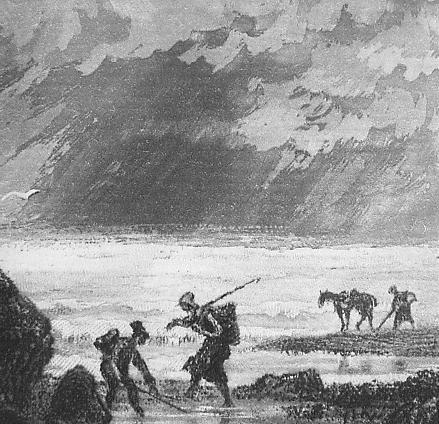
Architectural Print:
Usually a steel engraving or a lithograph, depicting a
building (church,
cathedral, etc.), its architectural details, sections,
elevations, etc.
It is distinguished from a regular steel engraving by high
precision and
very accurate depiction of the subject.
Aristotype:
Dr.
Liesegang, of Dusseldorf, introduced paper prepared with gelatin
and
chloride of silver to print out in the same way as albumenised
paper.
The prints can be toned and fixed at one operation. When a print
with
very highly glazed surface is preferred, this paper gives
perfect
results.
Artigue Process:
A modification of one of the oldest methods of printing in
carbon.
Artist's Proof:
An
impression of a print taken in the printmaking process to see
the current
printing state of a plate while the plate (or stone, or
woodblock...) is
being worked on by the artist. Artist's proofs are taken after
the Remark proofs
are made. The Remark is polished off of the plate and the
Artist's
proofs are taken. These usually number 200. Like the Remark
proofs,
they are executed with the most painstaking care; but they, of
course,
lack the value of the mark which stamps the first impressions of
an
engraving as cherished rarities. The Artist's proof is
distinguished by
the name of the painter and the engraver or etcher. When the
name of
either the one or the other is omitted, as may be in case of the
death
of artist or engraver, the value of the proof is not impaired.
Any
signed proof, with one or two names, is an Artist's proof. If no
Remark
proofs exist they are the first impressions taken, otherwise the
second.
Artoype:
Obernetter, of Munich, invented this improvement on the
Albertype in
1878. He uses a mixture of albumen and soluble glass for the
foundation
film, on which the sensitive film is afterward placed. As this
film
does not require to be hardened by light, opaque metallic plates
may be
substituted for the plate glass of the Albertype; otherwise the
process
is substantially identical with that of Albert.
Atramentum: A
black
pigment.
Autochrome:
Autochromes
color photographs were made by a process patented in 1904. An
autochrome
was a colored, transparent image on glass. The color came from a
layer
of translucent granules of potato starch, each dyed red, blue or
green
to create a coloured mosaic on the glass plate. During exposure,
light
travelled through these granules to reach a light sensitive
layer below;
red granules would only allow red light to travel through, and
so on. The
light sensitive layer was thus selectively exposed by color.
When the autochrome
was held up to the light, the coloured granules were viewed in
combination
with the black and white image behind to create a color
photograph. Below
is an overall view and an enlarged detail of an Autochrome
print from early 1900s..
Autographic Paper:
Paper used in Lithography to
transfer drawings
upon the stone.
Autographic Process:
Sometimes called the auto-lithographic process consists in
drawing the
image on lithographic transfer paper and then transferring the
image onto
a lithographic stone or similar surface for printing.
Autotype:
Autotype consists in coating a sheet of prepared paper with a
mixture of
gelatin, bichromate of potass, and carbon, and when dry,
exposing it under
a negative. On removal from the printing frame, the pigment is
moistened
with water, and laid, prepared side down, on a support of glass,
zinc,
or shellac-coated paper, to which a gentle pressure makes it
adhere. The
paper is then removed, and the print developed by immersion in
warm water,
which dissolves the unaltered gelatin, but cannot touch the
parts rendered
insoluble by the light which has passed through the negative.
The developed
print is again transferred to paper, when the high lights are
found to
consist of those parts where the gelatin has been completely
dissolved,
the middle tints of the parts less soluble, and the shadows of
the parts
quite insoluble. The pictures thus produced are admirable. The
chemical
durability or resistance to fading is absolute. The reproduction
of certain
objects, such, for instance, as an engraving may be made a
perfect fac-simile
of the original. Also called Permanent Photography.

Enlarged:

Autotypography:
method
invented by George Wallis, by which drawings or photos on
gelatin can be
transferred under pressure to soft metal (e.g. lead) plates for
printing.
Azure: A blue
pigment.
Back Painting:
A method
of staining mezzotint prints with varnished colors, after they
had been
affixed to glass, giving them the effect of paintings on glass.
Bartostype (by J. Bartos, Bohemia):
A stone or a zinc plate is coated with a varnish made of
asphaltum and
mastic. Upon the stone or plate so prepared a gelatin wash-out
relief,
made by the pigment-printing process, is mounted and treated
with a
mixture of glycerin and water in which a small quantity of alum
has
been dissolved. This relief is exposed to the sandblast, which
destroys
it, at first in its thinnest part and gradually also in its
thicker
parts. The destruction of the gelatin film lays bare the
varnish, and
allows the sandblast to act upon it in proportion to the
gradations of
the original from which the relief film was made. The result is
a
picture on the stone or plate in which the darks are represented
by the
varnish, the lights by the bare stone from which the varnish has
been
removed by the sandblast, and the gradations between the two
extremes
by the varnish more or less perforated by the blast. The stone
or plate
is now gummed, and after the varnish has been removed with
turpentine,
it is rolled up, and otherwise treated like a lithographic
transfer.
Ben Day Process:
A method of applying dots, lines, or texture patterns to engravers
metal plates, using an acid resist, so that when the Ben Day plate is
etched, the pattern will print in the areas only where it was applied.
These tints may also be laid on negatives or evenon the original copy.
Bite: The depth of the etch attained by each separate application of the etching acid.
Biting-In: A
term
used in engraving to describe the action of the aqua-fortis upon
the copper
or steel, on those parts from which the etching ground is
removed by the
graver or other tools.
Bitumen Process:
Bitumen or asphaltum varies very much in its properties; some
kinds are
soft, others hard, and some are fluid, as naphtha and petroleum.
The
kinds used in photography are found in Syria, the Island of
Trinidad,
and some other places.
The discovery by Niepce that the resinous substance bitumen or "
Jew's
pitch " was made insoluble by exposure to light has proved of
great
value in some of the recent applications of photography.
Niepce's first
experiments were made by spreading a film of bitumen on a
lithographic
stone; by means of acid the picture was then "bitten in" and
could be
printed from. This in his hands never became of any value, owing
to the
want of sensitiveness, an exposure of many hours being necessary
to
obtain an image; but he also tried glass and metal plates in his
later
experiments, when iodine was introduced, eventually leading to
the
discovery by Daguerre of the process known by his name. A thin
film of
bitumen is now made use of in most of the processes for printing
on
zinc, and the best results are obtained by this means.
Bichromated
gelatin can be used; but the results for the finer kinds of work
are
not equal to those obtained with the bitumen.
Bleach Print: A
photographic print used as a basis in a pen-and-ink drawing. The
photographic tones are chemically bleached out. The drawn image
remains.
Blueprint Process:
A simple photographic process, in which any uncoated paper is
covered
with a solution of potassium ferricyanid and ammonia-citrate of
iron,
either one being quite soluble in water. An ordinary negative is
used
and the light acting through it the two chemicals are combined,
forming
an insoluble blue, closely allied to prussian blue. The
unaffected
chemicals are removed by simply washing thoroughly in plain
water.
Bonnaudtype:
On a lightly printed photograph, used to give the general
outline, the
colors are laid in flat tints by hand, or they may be printed
lithographically, in which case the lightly printed photograph
can be
dispensed with. The colors themselves are either mixed with
albumen, or
the paper is again albumenized over them, and sensitized as
before. It
is then exposed once more under the same negative, and the
picture this
time is fully printed. The photograph, therefore, is either
developed
in the layer of colors, or the colors are under the photograph.
Bromide Paper:
A paper in which bromide of silver, in emulsion, is the
sensitive salt.
Bromide Printing
Process:
When opal glass and paper are coated with silver bromide
emulsion in
gelatin, they may be used for contactprinting or for
enlargements,
either by artificial or by day light; but for contact-printing
artificial light is to be preferred. Paper is prepared in two
degrees
of sensitiveness, the slow kinds being more suitable for
printing by
artificial light and for enlarging by daylight, while the rapid
paper
is used for enlarging by artificial light.
Brushing up:
The application of a resincus powder called Dragon's Blood against the
sides of the areas which are in slight relief as a result of an etching
bite. Protection of these sidos prevents undercutting during the
successivebites required for deep etching.
Bur: A slight
ridge
of metal raised on the edges of a line either engraved by the
burin, or
the dry-point, and which is removed by the scraper, as it
retains superfluous
ink in printing a plate, and has the effect of a smear.
Burin, or Graver:
An instrument of tempered steel used for engraving on copper.
Calender paper:
In paper-making, a machine with rollers between which paper is
passed
to w give a smooth, glossy finish; when the rolling has been
frequendy
repeated the paper is said to be supercalendered.
Calico printing: Production of colored
patterns on cloth
Calotype: also
called
TALBOTYPE, early photographic technique invented by William
Henry Fox Talbot
of Great Britain in the 1830s. In this technique, a sheet of
paper coated
with silver chloride was exposed to light in a camera obscura;
those areas
hit by light became dark in tone, yielding a negative image. The
picture
was fixed with the hyposulphite of soda.
Camayeu: From
French
for monochrome.
Camera Lucida: An
optical device having a prism which enables the eye to bring into focus
an original to be copied and the drawing paper on which it is to be
copied. A phantom image of both in one plane permits tracing the image
in different scale of reductions orenlargements.
Carbon print:
Carbon printing was introduced from 1864. A photographic process for
color printing on paper from separation negatives. Prints on yellow,
red, and blue sensitized carbon tissue are made by contact with special
bromide prints from the separation negative. Hence the name is
"Car-Bro". After development the three separate color prints are
transferred inregister to a permanent support.
Ceramic Photographs: Vitrified
or burnt-in photographs may be made in various ways. When the
processes
have been carefully performed, the results are very beautiful,
and, of
course, absolutely permanent. Probably owing to the difficulties
in
manipulation, vitrified photographs are not commonly met with.
To the
skill of the photographer must be added that of the enameller;
and when
colour is attempted, that also of the miniature painter.
Cereographic Engraving:
Is executed in wax spread in a thin coating on a copper plate.
The
drawing is incised in the wax, and type, figures and other
characters
may be pressed into it. An electrotype plate is made from this
and is
used as the printing-block. Also called wax engraving.
Cereography: A method of making stereotype plates from inscribed
sheets of wax.
Cliches-verre:
A process
pioneered by Corot in 1850s that involved creating by hand a
glass photographic
negative from which a photograph was made.
Chalcography:
A 17th, possibly even as early as 15th Century term for
engraving on copper, compounded from the Greek chalkos,
copper, and gropho, to cut , or incise lines.
Chemitype: An art of producing on
a metal plate, by a chemical process, an engraving in relief.
Chinese Paper:
A fine
absorbent paper of a yellowish tint. It is also termed India
paper.
Chromatone:
A photographic process for color. printing on paper somewhat similar to
carbro except that the colors in the individual prints are attained
chemically rather than from either dyes or pigments.
Chromatype:
Many
photographic processes are curious and interesting from a
scientific
point of view. The late Mr. Robert Hunt originated several of
this
kind. The Chromatype is a good example. Mr. Hunt says: " This
process
is a pleasing one in its results; it is exceedingly simple in
its
manipulatory details, and produces very charming positive
pictures by
the first application."
Chromo-collotype:Chromocollotypes
are
produced with a number of Collotype plates, using differently
colored inks. The negative to be reproduced is first blocked
with
opaque varnish in all parts except those required to be
reproduced in a
certain color. From this a collotype plate is made to be used
with that
colored ink. The varnish is then removed and the negative
blocked for
another color, and so on. In printing, the paper is passed
through with
the different plates until all the colors have been printed on
it,
forming a complete many-colored image. Instead of blocking out
the
negatives they are sometimes made by photographing the object
through
different colored screens, which have the effect of shutting off
or
absorbing some colors and allowing others to pass through
undisturbed
to the sensitive photographic film.
Chromolithography:
(Illustrations below) Lithography
produced
in color.


Chromocyclograph: A
picture printed from several blocks bearing different colors.
Chromotype: This is another name for the autotype process,
modified somewhat in the details of working.
Chromotypograph: An
obsolete graphic arts or printing related catch all term used
to describe
any number of obsolete processes which used cold and warm
rinse etching
baths to create surfaces by which color images could be relief
printed
from zinc plates in the letterpress manner. Such processes, as
pioneered
by Firmin Gillot represent a prototyping and experimental
stage between
the manual and process printing eras and are characterized by
their utilization
of various hand-originated textures AND photographically
transferred tones
or outlines, which when combined with other color plates
produced in a
like manner could produce continuous tone color images unlike
those found
in similar technologies such as chromolithography.
Chromotypogravure:
Produced by the same process as Typo-gravures, except that
several
plates are used with different colored inks. Figaro Illustre
is
embellished with pictures of this kind. They are made by
Boussod,
Valadon & Co.
Chromoxylograph: A
picture printed in colors from wooden blocks.
Clay Surface Processes:
(" Kaolatype," from kaoline, China clay). A metal plate is
coated with
a composition of pipe clay, etc., and in this mass the drawing
is cut
with hook-shaped tools, down to the surface of the plate. A
stereotype
(metal cast) furnishes the printing block, to be used in the
type
press. The rapidity of these processes makes them useful for
quick
newspaper work of small dimensions.
Cibachrome:
Cibachrome uses metallic dyes to create an image on paper. It
is
claimed that color prints made by the Cibachrome process
(which can
only be printed from color transparencies), will last for at
least 100
years. However, since the process is only thirty years old, no
one
knows how permanent it really is. Some printers advertise that
they
guarantee their color prints for 200 years.
Cliche Verre:
A
method of creating a printing block by drawing a design with a
needle
on a glass plate coated with an opaque substance ( a
glass-negative).
The printing surface was coated that with a thick layer of
light-sensitive gelatin, which was then exposed to light thus
transferring the design on the glass onto the printing
surface.
The lines of the image then hardened on the printing surface and
the
unexposed gelatin was then washed away with warm water, leaving
the
image in relief.
Coated paper:
Type of paper produced to create surface suitable for the
printing of fine-screen
halftones and other fine images. Coated paper must be
uniformly smooth,
receptive to printing inks, have high brightness and gloss.
Paper has been
coated to improve its surface for better reproduction of
printed images
for over 100 years. The introduction of half-tone and colour
printing has
created a strong demand for coated paper. Coatings are applied
to paper
to achieve uniformity of surface for printing inks, lacquers,
and the like;
to obtain printed images without blemishes visible to the eye.
The chief
components of the water dispersion used for coating paper are
pigment,
which may be clay, titanium dioxide, calcium carbonate, satin
white, or
combinations of these; dispersants to give uniformity to the
mixture or
the "slip"; and an adhesive binder to give coherence to the
finished coating.
Collodion: A
colloid used in photo-mechanical work for negative making. Its
advantage over gelatine is that it allows the making of an
extremely
dense negative with a thin film. Consists of guncotton,
dissolved in a
mixture of equal quantities of alcohol and ether.
Collodion Positives: See
AMBROTYPE
Collodion process: A
wet-plate process in which a negative is made by coating a glass
plate
with a Collodion. The plate is
inserted into
the camera, efxposed while wet, and developed immediately
thereafter.
Collographic processes:
have suffered more than any others from the mania for
high-sounding
names. The prints resulting from them have been dubbed gelatin
prints
— which, being English and simplest, would be better even than
collographs or collotypes — phototypes, heliotypes, albertypes,
autotypes, indotints, photophanes, glyptographs, and, worse than
all,
photogravures, this latter in the attempt to make them pass for
what
they are not, i. e., prints from intaglio plates.
Collotype: A
lithographic-like process where a substrate (traditionally
glass but
also
metal) is covered with a coat of gelatin sensitized with a
dichromate
and
dried at a specific temperature producing a reticulation of
the
gelatin.
After exposing and developing, this very fine pattern of
reticulation
will
selectively hold the ink, producing very fine half-tone
images. Of all
the photo-mechanical processes, the collotype is perhaps one
of the
most useful. It has a variety of names, such as Lichtdruck,
Phototype,
Photophane, Phototint, Albert-type, Artotype, and many others.
Below is an
overall view and an enlarged detail and a pattern of a Collotype print from
early 1900
Collotype in color:
Albert, Bierstadt, Frisch and others have succeeded in
producing very
beautiful pictures in colors, by preparing several gelatin
plates,
each plate bearing particular parts of the picture, and being
used for
printing the appropriate colored ink. As many as seven
different plates
are employed successively in producing the picture. There are
different
methods in use for preparing the several plates. One plan is
to make a
separate negative for each color. This is accomplished by
interposing a
suitable screen of colored glass, or colored liquid, between
the object
and the photographic plate in the camera. For example, a
screen which
shuts out all colors except blue will permit only the blue
portions of
the picture to be photographed on the negative, and a gelatin
plate
from this negative may be used for printing with blue ink. In
a similar
way another screen will furnish a negative and plate for the
red
portions of the picture, and so on. Another plan is to prepare
the
gelatin plates from one and the same negative by " stopping
out " all
of the picture except that of one color.
Conte Process: A
simple lithographic or relief engraving method without
photography. A
zinc plate is covered with a varnish soluble in water. The
design is
etched through this varnish with a stylus of ivory or
hardwood, after
which the whole is covered with an oil varnish and put in a
slightly
acidulated bath, in which the water varnish dissolves, taking
its
covering of oil varnish with it, leaving the plate clear
except in the
portions laid bare by the stylus, where the oil varnish sticks
to the
metal. The plate can be printed from lithographically or
dusted with
resin and etched in relief.
Cross-line Screen:
Halftone screen composed of black lines which cross, leaving
transparent apertures, symmetrically arranged and of uniform size. To
be distinguished fromOne Way or Single Line screens.
Copperplate
engraving:
Same as Engraving, Steel,
except that the medium is a copper plate (instead of a steel
plate).
Crayon-manner method: Invented
in the 18th century, crayon manner was purely a reproduction
technique;
its aim was the imitation of chalk drawings. The process
started with a
plate covered with hard ground (see below Etching). The design
was created
using a great variety of etching needles (some of them
multiple). After
the design was etched in, the ground was removed and the
design further
developed with various tools. Fine corrections and tonal
modifications
were made with scrapers and burnishers. Finally, engraving was
used for
additional strengthening of the design. Pastel
manner is essentially the
same as the
crayon manner except that it is usually used to imitate pastel
drawings.
Cross-line Screen: Halftone
screen composed of black lines which cross, leaving transparent
apertures, symmetrically arranged and of uniform size. To be
distinguished fromOne Way or Single Line screens.
Crystalotype:
A sun
picture taken on glass by the collodian process. The
crystalotype is formed
at once, and imparts to the positive or reflected picture a
greater clearness
of detail, and finer tone than Talbotype, which uses a negative.
C-type print:
A c-type
print is a color print in which the print material has at least
three emulsion
layers of light sensitive silver salts.
Cyanotype:
(Blue Prints) The cyanotype
process for making prints was invented by Sir John Herschel in
1842. A
sheet of paper was brushed with iron salt solutions and dried in
the dark.
The object to be reproduced was then placed on the sheet in
direct sunlight.
After about 15 minutes a white impression of the subject formed
on a blue
background. The paper was then washed in water where oxidation
produced
the brilliant blue - or cyan - that gave the process its name.
Daguerreotype:
An
ingenious invention, named after the originator, M. Daguerre, a
celebrated
dioramic painter. The process consisted of exposing silver
plates to the
vapor of iodine ; these were then placed in the CAMERA OBSCURA,
and after
sufficient exposure, the light acted upon the iodized surface of
the plates,
which were then exposed to the vapor of mercury, by which the
latent image
was developed. The iodide of silver was then washed off by
a solution
of the hyposulphite of soda, by which further action of the
light was stayed,
and the image on the plate rendered permanent. Such was
the state
of the discovery when first made known. Combinations of bromine
and chlorine
have been introduced more recently, and the result has been a
most remarkable
acceleration of the process, and the application of the
daguerreotype to
the obtaining pictures from the life.
Damaskeening
(damascening):
This term, derived from the Syrian Damascus, so renowned in Art,
designates
the different kinds of ornament upon a steel surface. The
first is
the many-coloured watered Damascus blades; this is the true
damaskeening,
produced by using a cast-steel highly charged with carbon,
which, on being
carefully cooled, produces a crystallization of these
substances, giving
the peculiar appearance to the steel, by which it is known. The
second
kind consists in etching slight ornaments on polished steel
wares. The
third is the inlaying of steel or iron with gold and silver, as
was done
with sabers, armor, pistol-locks, and gun-barrels. The designs
were deeply
engraved, or chased in the metal, and the lines filled with gold
or silver
wire, driven in by the hammer, and fastened firmly. This art was
brought
to great perfection by the French artist Corsinet, in the reign
of Henry
IV.
Dawson's Process:
An electrotype photo-intaglio process invented by Alfred Dawson. The etch line, instead of being bitten
into the plate is made to stand up in relief.
Diaglyph:
An
intaglio or design cut into the material on which it is
executed.
Die:
A
metal block or mould having an inverse figure or ornament, which
may be
struck or cast in relief in any decorative process. In
architecture
the word is applied to the cubical part of a square pedestal
between its
base and cornice, and which is generally a true solid square.
Die engraving:
(sometimes
termed DIE-SINKING). The art of engraving on steel molds,
medals, coins, and inscriptions. It was practiced by
the Greeks
with wonderful perfection ; and the Syracusan medallion, the
coins of Alexander
and some of the Greek cities, have not only never been
surpassed, but have
not yet been equaled. With the Romans the art was
extensively practiced,
and the coins of Hadrian may be cited as fine examples of their
power,
though scarcely so vigorous and artistic as the Greek.
With the fall
of Rome the art sunk to the lowest degradation. The
die-engraver
uses the metal in a soft state for engraving upon, and, as he
works the
reverse way (that is he cuts or sinks those parts of his design
which are
to appear raised), he continually takes impressions in clay of
his work
as he proceeds, in order to judge of its effect, and make the
necessary
corrections. When finished, the steel die is
hardened by fire
; and great risk is run in the process, as the metal will
occasionally
split and ruin the artist's labor. The same
risk is run
in striking the coin or medal, the die sometimes breaking after
a few blows
; the artist is, therefore, always uncertain of the issue of his
labors.
Die-sheet:
In box and carton work, a proof taken from the cutting die is used for
checking drawings, negatives, plates, and proofs for size. Die sheets
are proofed on cardboard and varnished to preventchanges in size.
Die sinking:
See
DIE ENGRAVNG.
Donistrophe Process:
A
method similar to hydrotype, whereby an ordinary negative is
made to
take a stain selectively, and prints are made by placing the
soaked
negative in contact with a gelatine-faced paper.
Double Printing:
The process of printing on metal from one negative, and then making a
supplementary print either from the same or another negative. When the
double prints overlap in any way, the process is called surprinting,
and toquires a re-sensitizing of themetal.
Dragon's Blood: A
deep red resinous powder used to protect certain areas of a plate from
acid actions while others are being etched. It must. be melted with
heat before itbecomes a complete resist.
Drypoint: The
term
applied to the sharp etching-needle, when it is used to incise
the copper
in fine lines, without the plate being covered with
etching-ground, or
the lines bit-in by acid. Very delicate work is produced
by this
means, which wears less in printing than lines produced by the
action of
acid.
A more detailed description of dry-point that
accompanied
the print of which the detail is shown below: Mr. Hardy's plate
in this
volume is in pure dry point. Mr. Hardy took a plate of
copper and
drew upon it with a sharp steel point, every stroke being a
scratch on
the polished surface. Now there is something peculiar in
the nature
of a scratch as distinguished from an etched line. When a line
is bitten
the copper is dissolved out of it by the acid, and therefore is
simply
absent, but with a dry point line it is not so. Here the
disturbed copper
is raised up out of the furrow and pushed either to one side or
the other,
or to both sides at once, and the way in which it is pushed
aside depends
upon the artist's manner of holding the needle. This raised
copper is called
the bur, and it catches ink when the printer inks the
plate. You
notice a certain softness at the edge of the line, a shade, as
it were,
outside of the line; well, this is the consequence of the bur,
for if there
were no bur that soft shade would not exist, and you would only
have an
impression of the clear sharp line itself, which would have the
appearance
of a fine engraved line. The bur can be removed very easily, and
then you
get something like engraver's work; or it can be left, and
then you
get something which resembles mezzotint in quality and is really
the same
thing as mezzotint in principle.
Both kinds
of dry point are very valuable resources, and are often
employed
by skillful etchers at the finishing of a plate. It
has been
said that dry point is to an etching exactly what glazing is to
an oil
picture, it gently darkens and softens the work, and throws over
it, as
it were, a veil of a different quality from its own; but though
this is
true it is not the whole truth, for dry point enables an etcher
to add
passages of extreme delicacy which would otherwise be beyond his
reach.
The diamond may be used for some of these, as it
cuts delightfully
and is held like a
pencil. But
not only does dry point add to an etcher's
resources
at the upper end of the scale, it enables him to add richness
and softness
to his darks. The reader may see for himself, in Mr.
Hardy's
pure dry point, the sort of quality which is attainable in it.

Dry-collodion Process:
Same
as Collodion process except it
allows
the plate to be exposed and developed at a later time. It
requires a much
longer exposures.
Dry Plate: In
photography, it is a glass plate coated with a gelatin emulsion
of silver
bromide. It can be stored until exposure, and after exposure it
can be
brought back to a darkroom for development at leisure. These
qualities
were great advantages over the wet collodion process, in which
the plate
had to be prepared just before exposure and developed
immediately after.
The dry plate, which could be factory produced, was introduced
in 1871
by R.L. Maddox. It was superseded by celluloid film early in the
20th century.
Duograph:
Two-color halftones made from the one-color original, each plate from a
separate screen angle negative but color plate only flat-etched.
Duotype (or Duotone): process
of printing from two half-tone blocks made from the same
negative. The
photoengraver makes two plates from the same halftone
negative, one of
these halftones to be etched crisp and sharp and the other to
have the
dots kept thick, with the shadows well filled up. The last
halftone is
printed in a tint of soft ink and the crisp halftone in a
dense ink of
the same shade of color as the tint, and the result will be
beautiful.
An improvement on this is called "Duograph," where two
halftones are
made from the same copy but with the screen lines at different
angles.
These are printed in two tones of the same ink, and the effect
is so
superior to printing from a single halftone. Below is an overall view and an
enlarged detail of a Duotype print from early 1900s.
Duplex half-tone: See Half-tone, duplex
Ectypography:
A mode
of Etching by which the lines are
raised on
the plate instead of sunk in.
Electrotint:
An art
of preparing tinted plates by the action of electricity on a
copper-plate,
whose surface is sunk, and which thereby produces a fine tint in
relief,
for use in the ordinary printing-press. In 1842 the process was
described thusly:
Electrotint Painting is the art of producing
paintings or drawings in such a manner, and so prepared, that,
by means
of the Electrotype process, copper plates or "blocks" can be
obtained
from them, capable, when printed from after the manner of
ordinarily
engraved plates, or wood blocks, of yielding fac-simile
impressions of
the said original paintings or drawings. It is well known, that
copper
and other metals can be deposited, by means of voltaic
electricity, on
any conducting surface, not liable to be prejudicially affected
by the
solution employed, so as to take an exact impression of that
surface—so
exact indeed, that the sharpest medals, as well as the most
elaborately
engraved plates, can be minutely imitated. By taking advantage
of this
important discovery, copper plates can be made from paintings
properly
prepared, and having surfaces rendered sufficiently conducting,
which
will multiply, and re-produce, as it were, the identical
paintings
themselves. The electrotint painting or drawing can be adapted
to both
methods of printing in common use; viz.—to produce either sunken
surfaces or indentations capable of receiving the printing ink,
in the
same manner as engraved copper-plates, or raised surfaces which
will
come in contact with the ink roller, as the type for
letter-press or
wood blocks, when set up for ordinary printing. Below is an overall view and an
enlarged detail of an Electrotint print from early 1900s..
|
|

|
Electro-phototypy:
A patent has been granted to Mr. H. Sutton for "an improved
process for
converting a photographic image on a gelatin surface into a
relief or
intaglio printing surface." The object of this process is, to a
certain
extent, to supersede the half-tone etching processes on zinc or
copper.
A negative is taken on a gelatino-bromide plate through a screen
of
lines, and by heating up to 212° F. a relief is obtained, which
is then
converted into a block by electrotyping. The process is capable
of
yielding a printing surface in half-tone; but as there is no
apparent
means of modifying the surface, as can be done in the half-tone
zinc
etching process, the usefulness of the new method must be
limited to
such subjects as do not require the finer class of work.
Electrotype:
A copper-faced duplicate, in one piece,
made from a page or form of type, engraving, or other object
which may be used to mould from. The process for making an
electrotype for printing purposes is as follows: The type is
locked, usually in small forms, in a chase, each page, as well
as the larger blank spaces, having around it metal guards of the
height of type. An impression is then made in a sheet of wax
having its surface dusted with black lead or plumbago. This wax
impression is then suspended in a galvanic bath in which copper
is present in a state of solution; the copper being affected by
electricity, leaves the solution and deposits itself in minute
particles upon the face of the mould. When the copper film is
thick enough it is stripped from the mould, and after a covering
of a tin compound, which acts as a solder, the film is backed up
with melted metal resembling type-metal. This produces a metal
plate with a copper face which is a duplicate of the original
type form or engraving. The finishing of the plate requires
beating up the low places to an even level, correcting defective
parts, shaving the surplus metal from the back to make it of
true and uniform thickness, and mounting on wood or otherwise to
make it type-high, and trimming the edges. When it is intended
to use the electroplates on the modern patented bases, or
blocks, they are simply shaved to a required thickness and the
edges beveled so that they may be held by small hooks attached
to the blocks. Elephant—A size of writing paper, 23 x
28 inches; in England, the sizes of elephant are: printing
paper 23 x 30, writing paper 23 x 28, wrapping paper 24 x 34
inches. (See also Steel Facing).
Below
is an overall view and an enlarged detail of an Electrotype
print from early 1900s.
Electros:
Small printing plates.
Elemine:
A crystallized
rasin.
Elephant Paper: A
term applied to designate the largest kind of drawing paper,
the sheet
measuring 28 inches by 23 inches. The larger kind of paper is
termed double
elephant paper, which measures 40 inches by 26 3/4 inches.
Empaistic:
Inlaid
work, resembling the modern buhl, or marquetry.
Emperor paper:
The
largest kind of drawing-paper manufactured, the sheet measuring
66
by 47ninches.
Enamel painting:
Painting
upon metal previously covered with glazed ground.
Encaustic painting: Another
term for Wax Painting.
Engraver's Tools:
This is a print from 1844 depicting engraver's tools and
methods. The print
depicts the following (taken from the original 1846 source) :
Figure 1. Etching on soft
ground
2. Etching 3. Etching finished with the graver 4. Mezzotinto
5. Aquatint
engraving 6. Stippling combined with line engraving 7, 8.
Manner of holding
the graver 7a. Engraver's easel 8a. Engraver's hand-vise
9. Manipulation
of cutting stones 9a. Engraver's oil-rubber 10, II - Tampons,
or dabbers
12. Common ruler 13. Parallel ruler 14, 15. Scrapers 16.
Burnisher 17.
Rocking-tool or cradle 18. Roulette 19. Scratcher 20-22.
Etching needles
23-26. Gravers 27. Callipers 28ab. Improved callipers 29, 30.
Punches 31,
32. Engraver's anvil and hammer 33. Lines made by the cradle
34. Reducing
frame 35. Frame for correctly observing curves on busts, etc.
36-38. Hands
for engraving stamps. There are as many as eleven
different modes
of engraving on copper, viz. 1. Copper-plate engraving
properly so called,
executed with the graver or burin; 2. Engraving with the
dry-point; 3.
Etching (fig. 2); 4. Etching and finishing with the graver
(fig. 3);
5. Stippling (fig. 6) exhibits this manner combined with (No.
1) ; 6. Mezzotinto
(fig. 4); 7. The Le Blon process with various colors; 8. The
chalk manner;
9. English stippling; 10. Aquatint engraving (fig. 5) ; 11.
The aquarelle
manner. The plate intended for engraving must be hammered
cold, or still
better rolled very hard; it must then be rubbed with
sandstone, next with
pumice-stone, and lastly with moistened charcoal ; after which
it must
be polished. For all the kinds of engraving-above mentioned,
excepting
Nos. 6, 7, and 11, the plate is now covered with a priming or
ground.
For this purpose it is placed over a hot charcoal
brazier; and then
is rubbed to and fro with the etching-ground tied
up in silk
(fig. 10), which is composed of wax, asphaltum, colophony, and
mastic or
Burgundy pitch. The etching-ground, which is liable to
come off in,
some places, is then evenly distributed over the plate by
means of Tampon's
dabber, a ball made of cotton wool tied up tightly in silk
(fig. 11), so
that .the ground is made of equal thickness throughout.
The design
is then copied in outline on the ground. For this purpose the
ground is
either whitened with washed white-lead and gum, or fastened in
a hand-vice
(fig. 8a) and blackened by passing it backwards and forwards
over a wax
taper; and to this ground the drawing is transferred, in,the
usual manner,
with tracing paper or by pressure on the back of the drawing.
If the drawing
is to be on a smaller scale than the original, the reduction
is effected
by the aid of a reducing frame (fig. 34).
[George Heck Ikonographisches
Encyclopedia Bilder-Atlas]

Engraving: The
act,
process or art of producing by cutting, on metal, stone or wood,
either
incised or relief designs. Technique of making prints from metal
plates
into which a design has been incised with a cutting tool called
a burin.
At the beginning of the 19th C, the copper plate was used
instead of steel;
hence, the process is also called copperplate engraving. Another
term for
the process, line engraving, derives from the fact that this
technique
reproduces only linear marks. Tone and shading, however, can be
suggested
by making parallel lines or crosshatching. See also Woodcut.
This is how a difference between a wood and steel
engraving
is explained:
STEEL ENGRAVING (Illustration below) ...
in working
on metal (steel plate, copper plate), the lines that are
intended to appear
black are incised, the plate is then covered with ink, which is
then cleaned
off, so that the paper when pressed firmly on to the plate, only
receives
impressions from the engraved lines, the ink having remained in
these,
while it was wiped off from the surface portions. The untouched
surface
then appears as white areas on the resulting print.
WOOD ENGRAVING (Illustration below) ...with
wood
(a piece of wood block), the process is reversed. The lines that
are to
print black are left, only the spaces that are to be white are
cut away,
leaving the lines prominent, which, when inked with a roller,
are transferred
under the press to the paper.

As a result, black lines, however fine, are
readily produced
on metal plate, whereas on the wood block, they can only be
obtained by
cutting away the wood on each side, leaving the line. Engravings
on steel
thus are of much finer quality than engravings made on wood. The
relief
image is carved on the end grain of hardwood (rather than the
side grain
of soft wood as in woodcut printing). See also Photoxylography
below.
Engraving, Dry Point:
See also Dry Point. The production
of incised
lines on a copper or steel plate, mechanically, with a sharp steel
point,
as distinguished from etching, in
which the
lines are bitten in by acid. An engraving method in which the
design to
be printed is scratched directly into a copperplate with a sharply
pointed
instrument. Lines in a dry point print are characterized by
a soft
fuzziness caused by ink printed from a burr, a rough ridge of
metal thrown
up on each side of the furrow of the dry point line. The
course of
the line, however, is often abruptly angular when changing
directions,
because the metal of the plate continually resists the
engraving
point.
Engraving, Heliographic:
Photoengraving
or Photoetching, as on a plate
coated with
bitumen.
Engraving,
Photochemical:
A process of producing an engraved block or plate for printing,
as by photographing
the original on metal and etching away the metal in those
portions unaffected
by the light (also called Photoetching)
Etching: (Illustration
below) A process of engraving in which the incised lines are
produced by
the biting of an acid or mordant. The surface of the metal is
covered with
thin coat of wax, asphalt, or varnish, called etching-ground,
which is
scratched with the etching needle where lines are desired, and
the exposed
part subjected to acid, which then creates incised lines in the
surface
of the plate.

Etching, Calligraphic:A
process of etching in which the sketching is done with pen and
ink on a
clean copper plate. The plate or design when dry is covered with
a thin
etching-ground
or varnish, smoked, and then soaked in water to soften the ink,
which can
then be removed with the varnish by gentle rubbing, leaving the
design
to be bitten as usual.
Etching, Daguerreotype:
Photochemical process for biting in the dark places of a
sensitized plate.
Etching-Ground: The
coating
of wax or varnish on a plate used to protect the surface from
the
action of acid. It was made of bees' wax, Burgundy pitch, black
pitch and
asphaltum.
Etching Needle: The
needle
like steel implement used by etchers for tracing the lines
through
the etching ground.
Etching Revival: The
Etching Revival is the name given by art historians for a
period of time
stretching approximately from 1850 to 1930 and involving the
renaissance
of etching as an independent art form drawing its inspiration
from Rembrandt.
False Intaglio:Creation
of a plate impression after the printing of the image. It was
usually done
by passing a smooth copper plate through the press with a
sheet of paper
on which the image was already printed by other means.
Ferrotype:
See TINTYPE
First Bite:
A very short preliminary etch to establish sufficient relief for
brushing up and protecting with Dragon's Blocd, after which another
bite can be given for deepetching without undercutting.
Folio: Refers
to the
size of the print. The longer dimension of the sheet is higher
than 12
inches.
Foxing:
Brown-yellowish
stains or spots appearing randomly on old prints, caused by
chemical composition
of the paper and its reaction to the environment.
Frisquet: The
name
given by wood-engravers to the paper with which they cover that
portion
of the woodcut which is not yet cut away, but which forms no
part of the
engraving, when they are about to take a proof of their
work. It
is simply a square piece of paper, the center of which is cut
out in the
general form of the subject to be printed, the proof-paper being
thus protected
from contact with any ink but that on the surface of the lines,
which are
then rubbed upon the paper by aid of a burnisher.
Galvanography:
This
is one of the most beautiful and successful inventions of modern
times
(19th C), as by its means plastic objects, e.g., wood, stone,
coins, plaister-casts,
etc., and copper-plates when engraved, may be exactly copied in
copper,
and bronzed or gilt. The invention is especially valuable
for copper-plate
engraving, as by its means any number of duplicates
of the
original plate may be obtained. GALVANOGRAPHY, after many
experiments,
has produced. works of Art far surpassing the expectations at
first entertained,
and the uses to which it may be applied are multifarious; for
since the
first galvanic plate was taken, it has been used in all branches
of engraving,
having been found to unite all the Known methods of the graver
and etching-needle,
aqua-tinta, scraper, roulette work, etc., and, moreover,
is very
easy of execution.
Gelatin Process:
Since the properties of gelatin have been investigated in
connection
with the photomechanical processes, a number of methods have
been
devised for using gelatinous masses as printing surfaces without
the
intervention of photography. Several of these are described by
Poitevin. A well-known device of this kind is the hectograph, a
gelatinous mass in a tin tray, to which letters or designs in
writing
ink are transferred from a sheet of paper. From the transfer
thus
obtained a number of impressions can be made on sheets of paper
rubbed
against it, and the transfer can then be washed off, leaving the
gelatin in condition to receive new transfers. A process based
on
similar principles, for the reproduction of drawings in several
colors
at one impression, has recently been patented. The direct
transfer
process, by which transfers to stone can be obtained from
designs in
writing ink on paper, which have previously been transferred to
prepared gelatin, also belongs to this category, superseded the
wet
Collodion
process.
Gelatine printing: Gelatine is a
refined form of glue and is used for many purposes in printing.
It is the basis of the process known as the hektograph, by which
anything written with copying ink, after being transferred to a
sheet of gelatin, may be
again transferred from the gelatin to sheets of blank paper.
Several processes of photo-gelatin printing, known as
albertype, collotype, heliotype, etc., are very much like
lithography, a coating of gelatin upon a sheet of glass or
metal being used instead of the lithographic stone. The
gelatin method is also used to produce a plate which may be
moulded and the mould used to produce an electrotype of the
subject in relief. By etching through a gelatin film on copper
an intaglio plate is made, which is known as a photo-gravure.
See Hektograph, Heliotype, Photo-gravure, Process
Engraving. Genealogical Work—This class of printing
differs from ordinary book work because of the excessive use
of abbreviations, peculiar indentions, different sizes of
types, use of capitals, italics, etc. It often requires the
re-printing of old documents, with oldtime spelling and
phraseology, and usually has pages of difficult pedigree
charts.
Ghost crease (dashed
line in the illustration):
A light line indentation in the paper caused by the pressure of
the
edge of the folded print, or when a folded print is placed
adjacent to
a non-folded print. It develops over time in the prints bound
together
into books, folios etc.
Gigantography:
This name has been given to a new in screen process platemaking,
applicable to very large dimensions, such as posters or
show-cards,
patented in all countries.
process.
Gillotype: A printing
process using a zinc plate created by a photographic transfer.
Invented
by Mr. Gillot in 1872. Also called paniconographie. See also Relief-etching.
Glyphograph:
is a
block obtained by coating a plate of metal, or other substance
reduced
to an uniformly flat surface, with wax or composition. The
design is then
made upon the surface of the composition, which in its turn is
removed,
wherever it is wished to obtain a metallic deposit. The metal
block, when
obtained, is mounted on a wooden back, and is then capable of
being printed
from with type in the ordinary printing press.
Goupil Gravure: The
Goupil-gravure process is a method of making facsimiles of
water-color
drawings. The plate is carefully inked in by hand with the
different
colored printing inks, and the picture printed by one
impression. The
plate is cleaned and again inked for the next picture. The
method of
printing is, of course, very costly, as skilled artists have to
be
employed for coloring the plates. The results, however, are
truly fine,
and in some cases hardly distinguishable from the original
water-color
drawing.
Graphotype Process:
According to Knight's Encyclopaedia, a zinc plate is covered
with a
thick coating of oxide of zinc. Upon this the drawing is
executed with
an ink consisting of a chloride of zinc and a menstruum. Where
the ink
comes in contact with the coating, the latter is hardened by the
formation of oxychloride of zinc. The rest of the coating,
between the
lines, is removed by brushing and rubbing. In one form of the
process,
the adhering material is solidified by immersion in a solution
of
silicate of soda. The printing block is obtained by
electrotyping.
Invented by D. C. Hitchcock.
Gravure: An
intaglio
process of photomechanical printing, such as photogravure or
rotogravure.
It also designates a print produced by gravure or
the metal
or wooden plate used in photogravure.
Gypsography:
A method of creating a printing relief block by using a coating
of
hardened plaster. The design is made in a simlar way as in the
above Glyphograph.
Half-tint:
Same as
Half-tone.
Half-tone: Of
or pertaining
to a photographic process of making relief plates (see Relief
Process) for illustration, in which the entire surface
of the plate
is covered with a regular series of small dots, or a grating of
fine lines
in white. It serves especially for the direct reproduction of
photographs
and paintings. Same as Half Tint. A typical modern example of
half-tone
printing are photographs in the newspapers - under the
magnifying glass,
one can see a large number of regularly placed dots that make up
the picture.
To produce a half-tone block from a picture, a black and white
drawing
in tone, or a photograph, a negative is exposed in the camera in
the usual
way, with the screen quite close to it but not in contact; and
the subject
is photographed on to the negative through the screen, and what
is termed
a "screen negative" is the result. It is a photograph of so much
of the
original as could affect the negative through the little clear
squares
of the screen, and represents the tones of it by innumerable
dots and lines,
the size and proximity of which are regulated by the fineness or
coarseness
of the screen used.
Example of the Reproduction of
Half-tone Blocks
by the Electrotype process:
Half tone work with Max Levy's
400-line screen:

Half-tone, duplex (Duplex
halftone):
A screen reproduction in two printings from half-tone blocks
made fro a
monochrome original, one being used as a color tone. The method
is used
in both letterpress and offset work to give the impression of a
mellow
monochrome picture, being richer and better toned than is
possible fro
a single color half tone block
Duplex
half-tone:

Half-tone plate or
block:
In the early days zinc was the metal used for these half-tone
blocks; but
experience showed that though more difficult to etch to the
necessary depth,
the closer, denser texture of copper rendered plates of this
metal much
more suitable for the production of the best blocks, and zinc
now is used
only for inferior blocks. Whichever metal may be used, a sheet
of it, most
carefully planished, is sensitized with a coating of gelatin or
fish-glue
and bichromate of potash, dried and exposed under the screen
negative to
the action of light, as in the ordinary method of photographic
printing.
The action of the light hardens the gelatin film, the portion
not so hardened
being soluble by water. The plate with the gelatin picture in
lines and
dots is exposed to heat and the image is burnt in on the surface
of the
metal like an enamel, which enables the photographic picture to
resist
the subsequent etching. The plate is placed in a bath of iron
perchloride
and etched until sufficient depth is obtained. Wherever the
surface of
the plate is free from the lines and dots, it is bitten away by
the perchloride,
and the lines and dots are left in relief. This first biting in
the bath
produces a rather flat general impression of the original, and
is termed
"rough etching." To produce finer results, and to bring out the
contrasts
of black and white necessary to a good reproduction, the block
has to go
through processes of stopping out and rebiting similar to those
of etching
an intaglio plate. This "fine etching" calls for the artistic
taste and
judgment of the craftsman; and with a good photograph to work
from the
final quality of a block will depend largely upon its treatment
by the
fine etcher. A substitute for the acid bath has been found in an
acid blast.
The acid is driven in the form of a spray with some force on to
the surface
of the prepared plate, which it etches more rapidly and more
effectively
than the bath. Also called Process blocks. Below is an enlarged
detail of a picture printed from a three-color process block:
Half-tone engraving:
Halftone engraving is done practically by the same methods as
zinc
etching, the difference being that, when photographing the
design on
the metal, a screen is interposed between a sensitive plate in
the
camera and the copy. The tone screen varies in fineness from 80
to
250 lines to an inch, according to the coarseness or fineness of
the
plate required, this being determined by the finish of the paper
to be
used and the care with which it may be printed. The coarse
screen is
best suited for the rapid work and cheaper paper of a daily
newspaper,
while a screen of 135 to 200 lines, on smooth coated papers
printed on
slow presses, gives finer results in the picture. The finer the
screen
used, the shallower the plate can be etched, and the smoother
the paper
and finer the ink must be in order to print clearly.
An example of a two-color
half-tone using a linen screen:
Heavier (paper):
thicker (paper).
Hektograph: A copying process
for multiplying written or printed copies by means of a sheet of
gelatin. The writing is done on a sheet of paper with copying
ink; this sheet is then laid face down on the gelatin, which
receives the ink; when fresh sheets are pressed upon the gelatin
thus treated the writing is transferred to them, and copies are
thus duplicated till the ink is exhausted; twenty to a hundred
copies may be made from one prepared pad. See also Gelatine
printing.
Heliochromy:
(Literally
sun-coloring) A term applied to that process by which
photographic pictures
in their natural colors are obtained.
Heliogravure:
A print or plate produced by Heliography.
Heliography: An
early photographic process invented by Niepce, and still used
in photo-engraving.
It consists essentially in exposing under a design or in a
camera a polished
metal plate coated with a preparation of resin, and
subsequently treating
the plate with a suitable solvent. The light renders insoluble
those parts
of the film which it strikes, and so a permanent image is
formed, which
can be etched upon the plate by the use of acid. FROM "The
Amercian
Amateur Phorgrapher, 1895": Take a walnut board of the
size of the
photographic plate, fasten to this a thin sheet of copper, and
have this
made perfectly plane. After having cleaned it with ether, flow
it in the
same manner as a wet plate is flowed with collodion ; with
bitumen of Judea,
10 grammes; chloroform sufficient to dissolve. This operation
is conducted
in the dark room. Allow the plate to dry, and tnen expose ten
to fifteen
minutes in a printing frame, under a negative or, preferably,
a positive.
After this develop in a dark room with rectified sulphuric
ether, and wash
with water slightly alcoholized. There results a plate which
can be printed
from like a lithographic stone, with a simple ink roller,
after having
first moistened the plate with pure water. A sheet of white
paper pressed
on this plate gives a very good print, and one very simply
obtained.
Heliography, or Solar
Printing, includes all those processes by means of which
drawings,
manuscripts, copper-plate and other engravings, all products
of the
graphic arts, pattern devices and designs, such as lace,
leaves and
flowers of plants, and photographic negatives and positives,
which
allow light to pass through them unequally in different
places, may be
reproduced or copied, in the same size as the original,by the
direct
action of light. Below is a detail of a late 1890s Heliogravue
print by D'Espouy

Heliotype: Similar
to Collotype.
Between the years 1869 and 1872, Ernest Edwards, formerly of
London,
and later of New York, made a number of improvements in
collotype
printing
which resulted in the Heliotype. It is a
method of printing from a gelatin film upon
which the picture has been transferred by photography. From an
ordinary
negative is made a positive from which a direct impression in
ink can
be made on a printing press. The most
important features of the
improvements are the hardening of the gelatin film by chrome
alum, and
the detaching of it from the support upon which it is first
prepared.
When completed it is a thin sheet or "skin" of gelatin, tough
and
flexible. For printing it may be placed on a plate of zinc, or
it may
be attached to a cylinder. It may be preserved and used for
printing,
as occasion may demand. The
photos show an overall view of a heliotype print made (in
1881) from a
copperplate engraving.
Huebner-Bleistein (H-B) process:
of photo plate-making, patented by Toppan, is a photolithographic
method used to create printing plates for offset printing. It involves
exposing a light-sensitive plate to a negative image, followed by a
chemical development process to create a relief image on the plate. The
H-B process is known for its ability to produce high-quality,
accurately registered multi-color prints.
Hydrotope:
A bichromate dye process.
Hyalograph or Hyalotype:
From Greek words for glass and print. A hyalograph is a drawing
on glass—not
common ground glass, but dispolished for the purpose with a very
fine and
even grain. The instruments used are chiefly the lead-pencil,
the stump,
and a brush charged with more or less diluted Indian ink.
The drawing
is transferred by light to a sensitized etching-ground, though
the camera
is not employed and there can be no reduction. The process was
invented
by M. Dujardin, the well-known hdliograveur, and employed for
scientific
purposes. The process is, however, excellent for original work,
because
the reproduction, being so very direct, loses less than by any
other process
known—in fact, the loss is almost imperceptible, which cannot be
said for
any other photographic process. In the hyalograph the
intervention
of photography is reduced to a minimum—the passage of light
through the
glass. The plate is bitten like an aquatint. The
entire liberty
of correction enjoyed by the artist whilst drawing the
hyalograph, and
its extreme fidelity to the work of the draughtsman, make it
very agreeable
to artists and most easily adaptable to all the varieties of
personal idiosyncrasy.

India Ink:
also Chinese
ink. A black pigment composed of a mixture of lampblack or burnt
cork with
gelatin and water, scented with Borneo camphor and musk, made in
India,
China and Japan. Sold in sticks. Also, similar ink made of
sepia.
India Paper:
A
thin yellowish absorbent printing paper made in China and Japan
from
vegetable fiber and used in taking the first and finest proofs
from engraved
plates. (Often used by engravers
for fine impressions. It has a fine silky texture and takes ink
nicely. It is imported and is made from hemp, cotton, mulberry
bark, bamboo, and silkworm cocoons. India proofs are made on india
paper.)
India Proof:
An early
and choice proof taken on India paper from an engraved plate. In
taking
India proofs, the India paper, cut to the proper proportion, is
carefully laid upon the plate, a sheet of ordinary plate paper
is laid
over it and it is run through the press. The glutinous quality
of the
India paper and the pressure cause it to adhere to the plate
paper and
it comes out mounted and ready for use.
Indotint: In
this process, invented by T. C. Roche, of New York, the plate,
usually
of copper, is roughened or pitted by exposure to the sand-blast,
in
order to cause the sensitive film to adhere tenaciously. Extra
toughness and tenacity are also produced in the film by the
addition of
alcohol to the chromatized gelatin. After exposure under the
negative,
the unchanged bichromate is washed out and the plate is dried.
These
plates can be used in the power press, and 1000 copies an hour
may be
printed from them.
Ink-photo: This
name is given by Sprague, of London, to photo-lithographs in
half-tone,
prepared by a process which was kept secret. The pictures do not
show
the decided dotted character of the Meisenbach negative, but are
very
fine grained and soft. It is a process for reproducing surface
tints rather than lines. They used
a coarse grain for vigorous, dense negatives, and a finer grain
for delicate negatives. [Example
from 'The Portfolio' 1883, The Salutaion of Beatrice by Dante
Gabriel Rossetti]
 |
 |
Instantaneous engraving:
The engraved plate is obtained by making a drawing upon the
polished surface
of a steel plate with a greasy crayon, or any other substance
capable of
resisting a deposit of copper, without opposing the corrosive
action of
acid, when the plate is immersed in an acid bath of sulphate of
copper.
Upon immersion the bright surface of the plate immediately
becomes coated
with copper, but the acid of the bath gradually corrodes and
undermines
those portions of the plate, the surface of which is protected
by the greasy
drawing, eating it into a series of lines, from which the print
is produced
by the ordinary process of copper-plate printing. This process
is employed
for the outline designs used by potters, the design being
printed and transferred
to the surfaces of plates and other articles, which are then
filled in
and colored by hand.
Intaglio:
From the Italian word meaning incising or engraving, it
denotes printing
from a plate that has the lines engraved.

Intagliotype:
A process in which a bichromatcd gelatine film on a metal
plate is
exposed under a negative and developed with heated sulphate of
iron
solution until the lines are clear. The plate is then mounted
and
printed from..
Japanese Paper:
High
quality paper usually composed entirely of gampi. The
color
of the paper ranges from a golden yellow to buff. Their
weight ranges
from 100 to 200 grams per square meter.
Jean Berte process:
A water color ink printing process, competitive to photo-engraving. It
is a method printing from a rubber surface which is cut by hand, just
like a wood engraving or a linoleum print..
Laid Paper:
Having lines water-marked in it at equal distance apart, the
lines
being thin places made by the pressure of the wire screen
during
manufacture. It is customary to speak of paper being either
laid or
wove. These are misleading terms, probably originating not
with the
paper maker, but with the maker of the wire V screen upon
which
hand-made paper is made. For a wove paper, the screen used is
woven
like cloth; but for a laid paper, the wires of the screen are
laid in
parallel columns. The laid paper is of earlier origin than the
wove
paper; in fact, it was not till the year 1750 that the wove
screen was
used.
Leimtype: In
1887, Husnik, of Prague, invented a process for preparing high
relief
plates of gelatin that can be used for typographic printing in
an
ordinary printing press, either for the reproduction of
pictures or
letterpress. Husnik uses a thick plate of chromatized gelatin
and
exposes it under a negative as usual. He then attaches this by
means of
gutta percha to zinc or wood, thus making a firm but somewhat
elastic
foundation for the printing surface. He then develops the
surface by
treatment with a solvent, such as a saturated solution of an
alkaline
bichromate. This not only dissolves the gelatin upon which the
light
did not fall, but it also deepens and strengthens the relief.
The
development is stopped before any of the finest lines or dots
are
injured. The plate is dried and the lights are covered with a
solution
of opaque printer's ink, by means of a camel's hair brush. The
plate is
then exposed for a second time to the action of light, by
which it is
hardened and strengthened, not only on the surface, but also
on the
flanks of each line and dot. The black is then removed and the
solvent
is again applied to deepen the whites. These plates may be
used
directly in the press, and will print 100,000 copies. By
making wax
moulds from these plates they may be reproduced in copper by
electrotyping.
Letter-press: A method
of taking impressions from letters and other characters cast in
relief
upon separate pieces of metal, and therefore capable of
indefinite combination.
The impressions are taken either by surface pressure, as
in the common
printing press, or by cylindrical pressure as in the roller
press.
Letterpress:
Print; letters and words impressed on paper or other material by
types;
- often used of the reading matter in distinction from the
illustrations.
Lichtdruck:
The
name lichtdruck was used in Germany to designate the process of
printing
in greasy ink from a surface of gelatin. If a film of
bichromated
gelatin be dried at a pretty high temperature, be exposed to
light
under a negative, be then washed in water and dried, it will,
when
treated in the same way as a lithographic stone, display similar
properties—will, that is to say, absorb water and refuse a
greasy ink
in certain places, while in others it refuses water, but
subsequently
takes ink. The portions which take water and not ink are those
which
have not been affected by light, while those which take ink
readily are
those which have been greatly affected by light. Between these
two
extremes is a complete gradation represented in reality by a
reticulation or grain, but giving the impression, so fine is
this
reticulation, of a true half tone. Also called Phototype, Collotype or Phototypie
(in France). Bewlo is a detail of a late 1890s Lichtruck print.

Line Block:
A term used for both the printing surface and the resulting
print. As a
printing surface a line block is any relief block on which the
image
has been achieved other than manually but without the use of a
half-tone screen.
Line Engraving:
Variously termed Cut, Line-cut, Line-plate, Line Engraving, Line
Etching, Zinc, or Zinco. A plate for typographic printing resulting
from etching through a stencil-like acid-proof print on metalfrom a line negative.
Linotype: A
typesetting machine casting a line of type in a slug. The spaces
are
used to justify the completed line as it is brought to the
orifice if a
mold, and there cast in a type-high slug. Linotype machines have
been
in use since 1890.
Lithochrome:
Another
name for Chromolithography.
Lithograph :
(Illustration
below shows a monochrome lithograph) A print produced by Lithography
(see below). See also Chromolithography.
[example from 'Moyen Age
Pittoresque' by Nicolas-Marie-Joseph Chapuy, 1838]

Lithographic chalk:
Ingredients the same as in Lithographic
Ink with
a small quantity of potash added during the boiling.
Lithographic Crayon:
A crayon used in the 19th century for drawing upon stone. The
finest ones
were usually made of the combination of Finest White Wax, Finest
White
Tallow Soap, Pure Russian Tallow, Gum Lac and Finest Lamp Black
(for a
black crayon).
Lithographic ink:
Was made of tallow-soap, pure white wax, lamp-black, and a small
quantity
of tallow, all boiled together, and, when cool, dissolved in
distilled
water.
Lithography (process) :
The
process of printing from a flat stone. The design to be printed
is
drawn on a stone of peculiar quality with a specially-prepared
ink,
which clings to and dries on the surface. The surface is then
subjected
to the action of a weak acid that hardens the ink and slightly
etches
and lowers the unprotected parts. The process of printing first
requires moistening the surface with water, which is absorbed by
the
blank parts and repelled by the hard, greasy lines of the
design.
Printing ink is then rolled over the stone and is, in turn,
repelled by
the wet parts but adheres to the ink-drawn design. The stone
thus
prepared is ready to make an impression on the sheet. It will
thus be
seen that the theory of lithographic printing is based upon the
repulsion between grease and water. The production of the design
depends upon chemical manipulation of the printing surface. It
is the
most flexible of all methods of printing. The invention of
lithography is due to Alois Senefelder, an actor of Munich, and
was the
result of an accidental impression on a stone. He employed it in
printing music and afterwards, with others, developed the art
for
commercial purposes. Like other methods of printing,
lithographic work
was formerly done on hand-presses, but since about 1860
power-presses
have been employed and the progress of the art has made rapid
strides.
Many new and improved processes and details of
manipulation have been invented, both for preparing the design
on the
stone and for printing from the stone when ready. The
preparation of
the stone is done in several ways: by drawing on it with a
special
chalk or crayon; by line-drawing with pencil or pen with
lithographic
ink; by engraving through a thin film with diamond or steel
points; by
drawing or writing on prepared paper for transferring on stone;
by
transferring impressions taken from copper or steel plates,
wood-cuts,
or type; by photographing on stone; and by wash-drawing on
stone. The
lithographic hand-press has a movable bed, like that of the
typographic
hand-press. The impression is made, not with a platen, as for a
type
form, but with a straight-edge scraper at the press-head. The
bed moves
under this scraper, which extends across the width of the stone,
and
imparts great pressure on a small area at a time. The first
operation,
when printing, is to moisten the surface of the stone, so that
the
subsequent inking will leave ink only on the design. The inking
roller
is then passed over it; when sufficient ink has been applied,
the sheet
is laid on, the tympan laid down and the bed moved in under the
scraper. The back of the tympan is of leather, zinc, or brass,,
and is
slightly oiled to allow the scraper to pass over it with as
little
side-resistance as possible. Lithographic rollers are not made
of glue
and molasses, like those used for typographic work, but consist
of
wooden or iron cores, wound with felt or flannel and covered
with
leather. Lithographic power presses are similar to cylinder
presses
employed for typographic work.
A lithographic stone, after being used, may
be
ground down and have a fresh surface prepared for a new design.
Thus,
different thicknesses of stones must be used, and the distance
between
the bed and cylinder varies more than on a type-printing press.
The
cylinder is covered with a thick, elastic blanket or sheet of
india
rubber. The necessary moisture is applied to the face of the
stone by
rollers, which are at the opposite end of the press from the
inking
rollers. These damping rollers consist of iron cores, wound with
several thicknesses of flannel and covered on the outside with a
cotton
or linen fabric. Chromo-lithography is the process by which one
picture
is printed from many stones in succession, each stone printing a
different color. The comparative ease in making transfers of a
design
from one stone to another, and the greater degree of accuracy in
registering a number of colors over each other, have especially
adapted
lithography to color work. Photolithography is the process by
which the
design is placed on the stone by photography instead of by
hand-drawing..
Lithography (in offset)
:
See Offset Printing.
Lithogravure :
A term applied to a process in which the tints are impressed
on
transfer or other paper from engraved blocks, suitably cut
masks
preventing impression except where desired. The drawing so
prepared, if
on transfer paper, can be transferred to stone or zinc at
once,
otherwise an ordinary zinc etching is made by first producing
a
photographic negative.
Litho-offset (process) :
See
Offset
Printing.
Lithophotography:The
art
of producing prints from lithographic stones, by means of
photographic
pictures developed on their surface.
Lithotint:
Lithotint is the name given to a method of making drawings with
washes
of liquid ink applied with the brush to stone, like sepia or
Indian ink.
Lithotype:
A
print and the process of producing an impression in ink from a
gelatin film which has been chemically treated, the method being
similar to lithography.
Lumiere
color reproduction:
A process devised by Messrs Lumiere and described thusly:
A sheet of glass is first smeared with something sticky, and
then
hundreds of thousands, even millions, of infinitesimally small
coloured
potatostarch grains are scattered over it. They are of the three
primary colours—orange-red, blue-violet, and green; and they
must lie
quite close without overlapping. Any intervening space between
the
grains is filled in with black, to exclude all white light. The
grains
are then rolled even, and a coat of waterproof varnish laid on;
and on
that is laid the ordinary colour-sensitive emulsion. The plate
is put
in the dark slide the reverse way, so that the light from the
lens must
first pass through the coloured grains before it reaches the
emulsion;
and some of the colour is intercepted by a yellow screen, placed
before
the lens during exposure. Without that yellow screen everything
would
look as if seen through blue spectacles.The negative is obtained
in the
ordinary way, but goes through a great many more processes than
a
black-and-white negative. Colour-photography, of course, cannot
for a
long time, if ever, be as cheap as that without colour. White is
made
up of the three primary colours blended, and if the image is
enlarged
by the lantern it must be seen from a certain distance to look
white at
all. Below is an overall view and an enlarged detail of
Lumiere's process print from early 1900s.
|
|

|
Machine Engraving:
Machines are largely used in modern engraving, but only as
auxiliaries,
for ruling straight or wavy lines. In machine engraving
properly
speaking, the machine does all the work. There are various
kinds of
these machines : — guilloche machines (supposed to have been
invented
by one Guillot) or lathes, which produce ornamental designs
consisting
of interlacing lines, circles, etc., such as are used on bank
notes ;
medal-ruling machines, in which a point is made to travel over
the
medal or other low relief of which an engraving is wanted,
while by an
ingenious arrangement a second point, governed by the
movements of the
first, traces a series of lines, nearer together or farther
apart,
according to the variations of height in the original, upon a
metal
plate or a lithographic stone; and universal machines, which
do all
kinds of work. Most of these machines are so constructed
besides that
the design can be reduced or enlarged, or reversed. The first
medalruling machine was built about 1830, by Achille Collas of
Paris. A
similar machine was constructed somewhat later in the U. S. by
Joseph
Saxton. All the machines so far named are for intaglio
engraving. The
Shanks machine, on the contrary, produces relief blocks of a
simple
kind. The engraving is done by cutting the lines into a slab
of plaster
of Paris, thus producing a matrix from which electrotypes can
be made.
Manual Print:
Type of print whereby the image was created directly on the
printing surface,
for example drawn directly onto a wood block. Compare Process
Print.
Margin: A
white border
around the image. The part of the margin that is under the image
usualy
contains a title and other information about the image.
Metzograph: A
half-tone process made by the use of a grained screen instead of
a
cross-line screen. The picture reproduced by this screen has a
pebbled
softness of tones admirably suited to the interpretation of
certain
subjects, such as the foliage of trees, a growing crop of grain
or
grass, fur-bearing animals, a rough stone wall. Commercially,
the
screen is coming intofavor for the reproduction of garments,
textiles,
furs, feathers, etc. When a subject demands a firm, “contrasty”
treatment, the metzograph is not so good as the halftone. A
metzograph
plate is slightly more expensive than a halftone. Devised by
James Wheeler. Below
is an overall view and an enlarged detail of a Metzograph
screen print from early 1900s.
Mezzotint:
Mezzotinting reverses the order of most other kinds of
engraving,
inasmuch as it works from dark into light. This is why the
French call
it la manure noire. The English name expresses the fact that it
renders
halftints in apparently unbroken masses. Before the artistic
work of
the mezzotinter begins, the plate is worked all over with a
toothed
instrument, called the rocker, by which operation its surface is
broken
up into innumerable minute cavities which hold the ink. This is
called,
rather inaptly, laying a mezzotint ground. The coarseness or
fineness
of the ground depends on the number of teeth to the inch of the
rocker.
An impression from the plate in the state in which the rocker
leaves
it, presents a uniform velvety blackness. By careful scraping
with a
steel scraper, gradations from black to white can be produced,
the
action of the scraper reducing the depth of the cavities, and at
the
same time broadening the ridges between them. Clear whites
result from
the complete erasure of the cravities and polishing the smooth
places
thus produced on the plate. Mezzotint is used pure, or in
connection
with etching, graver work, stippling, etc. The process was
invented by
Ludwig von Siegen, whose earliest published plate is dated 1642.
Like
all artistic processes, mezzotinting suffered from the striving
after
mere mechanical perfection. The desire to produce a ground so
fine as
to obliterate all traces of the tool, led to smokiness and
vapidity.
The present tendency is, to return to more vigorous methods.
Overall View:

|
Detail:
 |
Mimeograph:
An apparatus
in which a thin fibrous paper coated with paraffin is used as a
stencil
for reproducing copies of written, printed, or typewritten
matter. The
impression of the pen or type spreads the paraffin, and makes a
porous
spot through which the ink may pass in printing.
Mixed Method Steel
Engraving (or Mixed Manner):
Combinations of various methods are found in many of the
specimens. In
modern engraving this way of working is largely utilized, and
there are
plates in which line etching, graver work, stippling,
rouletting,
mezzotinting, or sometimes aquatinting, and machine-ruling are
all
found together. Such plates are said to have been done in the
mixed
manner.
Monotype: The
monotype
is not a new, but a revival of a somewhat old method of
reproducing on
paper a painting by an artist. The design is executed on a plate
by means
of brushes, monotype fingers or other tools, with paint or
printer's
ink. On the completion of the painting, paper is laid upon it,
and plate
and paper are together passed through a press, when the ink or
color is
transferred to the paper. One impression only is possible, hence
the name
of the process. A method has been devised by Sir Hubert von
Herkomer for
dusting the painting while still wet with a fine metallic
powder, which
gives a tooth to and renders the surface sympathetic to a copper
deposit
when it is placed in the galvanic bath, by which means an
electrotype of
the painting, with its varying relief surfaces, is obtained, and
forms
a plate from which numerous impressions can be taken.
Mordant: A
corrosive liquid used to etch metal.
Mosstype: The
Mosstype process is a
photo-engraving process, differing
slightly in detail. This is first made in a composition of
asphaltum, sulphuretted resin, and caoutchouc, and from these a
second mould of plaster is made, from which a casting is made in
type metal to form the printing block.
Niello:
From which the method of copperplate engraving originated in the
early
part of the fifteenth century. Metal plates are decorated by
engraving
incised lines on them, and then filling up these lines with
black
enamel, after which the whole surface is polished. This is
called
Niello. Toinaso Finiguerra, an Italian goldsmith, proved his
niello by
rubbing into the lines a mixture of oil and lampblack and then
pressing
on the plate damp paper. Thus was copperplate engraving and
printing
discovered.
Niepce's Process or
Niepceotype: One
of the earliest photographic processes discovered by Nidpce. He
found
that bitumen became insoluble by the action of the light. A
metal
plate, coated over with a thin film of bitumen (dissolved oil of
lavender), was exposed to the image in the camera obscura, and
the
bitumen became insoluble in proportion to the intensity of the
light by
which the various parts of the image were produced. This effect
is, we
know, due to the oxidation and hardening of the resinous
substance.
After removal from the camera the exposed plate is steeped in a
mixture
of oil of lavender and petroleum; the soluble portions remaining
are
dissolved away. The shadows of the image are thus represented by
bare
portions of the metal plate, the insoluble resin remaining
representing
the lights and high lights. It will be clear that to get the
best
effect the polished metal representing the shadows should be
darkened.
For this purpose Niepce employed iodine and various other
chemicals.
Niepce, in a statement made in the year 1829,
thus
describes his process :—"The discovery which I have made, and to
which
I give the name of ' heliography,' consisting in producing
spontaneously by the action of light, with gradations of tints
from
black to white, the images received by the camera obscura. Light
acts
chemically upon bodies. It is absorbed, it combines with them
and
communicates to them new properties. Thus it augments the
natural
consistency of some of these bodies; it solidifies them even,
and
renders them more or less insoluble according to the duration of
intensity of its action. The substance which has succeeded best
with me
is asphaltum dissolved in oil of lavender. A tablet of plated
silver is
to be highly polished, on which a thin coating of the varnish is
to be
applied with a light roll of soft skin. The plate, when dry, may
be
immediately submitted to the action of light in the focus of the
camera. But, even after having been thus exposed a length of
time
sufficient for receiving the impressions of external objects,
nothing
is apparent to show that these impressions exist. The forms of
the
future picture remain still invisible. The next operation, then,
is to
disengage the shrouded imagery, and this is accomplished by a
solvent,
consisting of one part by volume of essential oil of lavender
and ten
of oil of white petroleum. Into this liquid the exposed tablet
is
plunged, and the operator, observing it by reflected light,
begins to
perceive the images of the objects to which it had been exposed
gradually unfolding their forms. The plate is then lifted out,
allowed
to drain, and well washed with water." Niepce further adds, "It
were,
however, to be desired that by blackening the metal plate we
obtain all
the gradations of tone from black to white. The substance which
I now
employ for this purpose is iodine, which possesses the property
of
evaporating at the ordinary temperature.
Offset printing:
Also called offset lithography, or litho-offset is widely used
printing
technique in which the inked image on a printing plate is printed
on a
rubber cylinder and then transferred (i.e., offset) to paper or
other material.
The rubber cylinder gives great flexibility, permitting printing
on wood,
cloth, metal, leather, and rough paper. An American printer, Ira
W. Rubel,
of Nutley, N.J., accidentally discovered the process in 1904 and
soon built
a press to exploit it. In offset printing the matter to be
printed
is neither raised above the surface of the printing plate (as in
letterpress)
nor sunk below it (as in intaglio, or gravure, printing). Instead,
it is
flush with the surface of the plate; thus offset is classified as
a planographic
method of printing.
Offset: A
more or less distinct transfer of a printed page or picture to the
opposite page, when the pages are pressed together before the ink
is
dry or when it is poor; an unitended transfer of an image from one
page
to another; called also setoff.
Offsetting: A
light
imprint of text or lines on the print or parts thereof from the
opposite
page. Occurs on the prints bound in magazines, books etc.
when the
print was not protected from the printing ink on the opposite
page by a
thin piece of paper.
Opus Mallei:
In Stipple
Engraving the use of a little hammer to produce dots.
Painter Etchings: There
are two classes of etchings in the trade—painter and
reproductive
etchings. The first named are the original works of the
artists, the
last copies by artists or engravers from the works of others.
Painter
etchings have the value of original works. They are esteemed
as showing
the methods and spirit of the artist, just as a sketch by him
would.
The fine etchings by A. F. Bellows are examples. Those who own
an
etching by this master really own an original drawing by him.
The only
difference is that it is drawn on metal instead of paper, and
can be
mechanically reproduced.
Paper aging/deterioration: Factors
That Promote Paper Deterioration:
■ Composition of paper and the conditions under
which it is stored.
■ Fibers made of cellulose chains
degrade when exposed to an acidic environment in the presence of
moisture.
■ The longer the cellulose chains
that comprise paper, the stronger and more supple the paper.
■ Early papers were made from
cotton and linen rags. Most early papers, especially those made
up to the middle of the 19th century, are still strong and
durable, especially if they were stored properly under
conditions that were not overly warm or humid.
■ Cotton papers owe their
longevity mainly to the length of the fibers used in their
manufacture.
■ The shortest fibers are found
in newsprint papers made from groundwood pulps; this pulp is
made by the mechanical grinding of wood that is then made into
paper without first purifying it chemically.
■ Alkaline papers can last
indefinitely. Acids formed within the papers or those absorbed
from the environment are neutralized before they have a chance
to degrade the cellulose chains. Alkaline paper contains an
alkaline reserve. This alkaline reserve, most frequently chalk,
neutralizes acids and also makes the paper look whiter.
■ Paper bound in books or aged
inside airtight enclosures ages faster than single sheets open
to the environment.
■ The deterioration due to
accumulation of acids -- whether they are acids absorbed from
pollutants, introduced in the manufacture of paper, or formed as
paper ages -- can be arrested by deacidification.
[Excerpt from the US Library
of Congress Research].
Papyrotint:
A process invented by a man named Husband for changing the
gradation of
tone in an ordinary negative into the grain of a lithograph, so
that it
can be printed from lithographically. It is a photolithographic
process
and the principle on which it is based lies in the property
ferricyanid
of potassium possesses to reticulate gelatin. Much care is
required in
manipulating this process and the lithographic printing must be
done on
a hand press.
Pastel-manner method:
See Crayon-manner.
Photoaquatint:
An
aquatint
made by a photomechanical process that involves the mixing of
carbon with
gelatin, exposing a film of this on a plate, and washing it out.
The film
is then laid on an aquatint ground, usually with a half tone
negative film
on top, after which the plate may be etched. It is chiefly used
for the reproduction of portraits taken direct from life.
Photo-caustic: This name is given to
photo-lithographs produced in half-tone by means of a Meisenbach
ruled negative.
Photochromo-lithography:
One of the most useful applications of photography is in making
transfers for lithographs of designs which have been printed in
colours. Each colour is printed from a different stone, and as
reduced
or enlarged copies are often required from such work, the
different
sizes may be obtained by photographic means, thus saving the
cost of
re-drawing. Impressions from each stone are taken in black, and
from
these transfers can be made.
Photochromotype:
A
photo process picture printed in colors in a printing press by
any of
the ordinary methods of typography in colors (see the sample
below
showing Charles's Bridge in Prague from a water-color painting
by
Jansa).

Photochromy:
color
Photography.
Photocollograph:
Early
term for Collotype.
Photo-collography: Same
as lithography except the image on the surface is made by
using a photo-negative
and projecting the image on the negative onto the stone
surface coated
with a light sensitive substance.
Photo-electrotype:
There are a very large number of photo-electrotype processes,
differing
in minor details. The process may be briefly described as
follows:—A
sheet of chromatized gelatin is exposed under a negative.
Parts are
thus rendered insoluble and incapable of absorbing water, the
remaining
portions, protected by the image of the negative, being
soluble and
capable of absorbing cold water. After exposure the gelatin is
immersed in cold water, when the absorbing parts swell up, or
else the
soluble parts are removed with warm water, acetic acid, or
other
solvent. The next process is the making of moulds in wax, or
plates
from the gelatin image; and from these copper blocks can
easily be
made for typographic printing by the electrotype process. If
half-tones
are to be represented the negative must be broken up into
lines, dots,
or stipple.
Photo Engraving:
The earliest process of engraving with the aid of photography
was the
bitumen process of Niepce. This was, in fact, the earliest
process of
obtaining permanent images by the action of light. Niepce
discovered
that certain varnishes became insoluble by the action of light;
he
covered metal plates with asphaltum or bitumen of Judea, and
exposed
them to the image in the camera obscura. After the exposures the
plates
were treated with a solvent, when the unexposed parts were
dissolved
away, leaving the insoluble negative image of bitumen on the
metal
plate. To convert this into a positive one, the plate was
treated with
iodine vapor, which attacked those parts of the metal
unprotected by
the bituminous image, which was then cleared away with a
powerful
solvent. By applying an acid to the bituminous images on metal
the bare
parts are eaten away, and by this means engraved plates were
obtained.
Bolas, the eminent authority upon photo-mechanical processes,
thus
described the modus operandi for producing photo-engraved plates
by the
bitumen process:—" Bitumen or asphalt
- Professor Minchin at the Physical Society.
dissolves readily in benzole, and the solution runs freely
through a
paper filter. The solution should not be quite as thick as
collodion. A
carefully-cleaned copperplate such as the engravers use, is
clamped
down on to a turn-table. The next step is to flood the plate
with
bitumen solution, and then to make the table revolve quickly.
When it
has revolved a few seconds the film will be dry. No other method
gives
such a uniform and compact film of bitumen as this. After
coating it is
well to put the plate aside for twelve hours, in order that the
film
may become harder. It is then necessary to dust it over with
French
chalk to remove stickiness, and after this it is placed behind a
transparency and exposed to light. The time of the exposure may
vary
from 20 minutes to two days.
When a plate has had the requisite exposure, the next matter is
to
dissolve away that portion of the bitumen which has not been
made
insoluble by the action of light. Now, benzole is generally too
energetic a solvent for the purpose, and oil of turpentine is
often not
sufficiently active; but by mixing these together you can get
any
degree of solvent power which you may require. The workman
commences by
flooding the plate with oil of turpentine, and if this has not
sufficient action he pours it off and adds a little benzole ;
this
begins to produce an effect, and enables him to judge as to the
amount
of benzole which he may safely add to the oil of turpentine.
When he
has added this quantity, and has washed away all the soluble
bitumen
from the plate, it is next thoroughly rinsed with water to
remove the
oil of turpentine. The plate is next placed in nitric acid, so
as to
etch the lines where the metal is bare.
Plates from which much printing is to be done are ordinarily
covered
with a thin film of iron, by the electrolytic method, and as the
film
of iron is extremely thin, it does not in any way interfere with
the
printing qualities of the plates. When the surface of a plate
begins to
wear a little, and the impressions show signs of deterioration,
the
film of iron is dissolved off by means of dilute sulphuric acid,
leaving the copperplate as good as ever. The film of iron,
although so
thin as not to injure the printing qualities of the plate, is
nevertheless sufficiently thick to protect the copper from
injury in
printing. The plate having been freed from the first worn-out
film of
iron, is once more coated with a layer of iron, and is again
ready for
use. When the second film of iron is nearly worn away, and the
printer
approaches near to the true surface of the copperplate, the iron
is
again dissolved away, and a new coating of iron is put on.
According to
this system. one really prints rather from a cast of the plate
than
from the original plate, and new casts are made as required..
Photoetch:To make
(a plate for printing) by etching on a photographically treated
metal surface.
Photo-etching process: When
a layer of asphalt or bitumen is spread over a surface and
exposed under a design, those portions of the film which are
acted on by light become insoluble in hydrocarbon oils, so that
the design can be developed by such solvents, and the surface,
if of metal, can be converted into a printing block by etching
with acid. The change experienced by the bitumen is probably the
result of photo-chemical oxidation. The processes based on this
property are much in vogue at the present [1894] time under
various modifications. This action oflight upon bitumen
furnished the earliest successful permanent reproduction of the
camera picture (Joseph Nicephore Niepce, 1824).
Photogalvanography:
The photorelief engraving process invented by Pretsch in 1868,
afterward modified in important ways and known as
photoelectrotype.
Photoglyphic Engraving:
A
process of photo-etching invented by Fox Talbot. A metal plate
was
coated with gelatin, sensitized with potassium dichromate, and
exposed
to light under a negative. It was then dusted with finely
powdered
copal and warmed until this melted. When cold it was covered
with
suitable etching fluid which soaked through the portions of the
film
unacted upon by light, and attacked the plate underneath.
Photoglyptie:
The French name given to the Woodburytype process.
Photogram: A photographic image, a photograph.
Photographic processes: Photographic processes
may be divided into two classes:
1. those which depend on the fact that certain salts of silver
darken under the action of light and
2. those which depend on the fact that under certain conditions
gelatine or analogous bodies are rendered insoluble under the
action of
light
These processes which may be again divided into
three classes:
1st. Those in which each print is itself a sheet of gelatine
acted on
by light, such as Carbons or Autotypes. Braun of Dörnach is well
known
for such productions, and in his method each picture is itself
formed
of a sheet of gelatine which has been acted on by light.
2d. Those in which one gelatine print is obtained by means of
light,
and is used as a means of supplying a metal or stone printing
matrix,
such as PhotoLithography, or the Woodbury process.
3d. Those in which one gelatine print is obtained by means of
light and
itself, that is, the actual sheet of gelatine itself, is used as
a
printing matrix, such as in the Heliotype process.
Photogravure: (Picture
below) The act or process of producing a plate for printing as
well as
the print made from such a plate. First, a picture of a
painting
or other object is taken on a sensitive film, the negative is then
prepared
and laid on a sensitized metal plate, which is then
developed and
bitten in with a mordant, producing a plate that may be printed
from like
from any other printing plate. Such a plate has no sharp incised
lines
(like a plate plate used for the steel engraving) , but rather
minute depressions.
The deep parts produce the shadows, and the high parts showing
white when
printed.
Photogravure reproduces the tones of photographs
or drawings,
and gives the nearest approach to a facsimile reproduction that
has yet
been arrived at. Gelatin bichromatized is the medium by means of
which
the photogravure plate is produced; but as the screen is not
used in ordinary
work, it is necessary to produce an ink-holding grain in some
way upon
the plate. This is done by allowing a cloud of bitumen dust,
raised inside
a box, to settle upon the surface of a copper plate; it is fixed
by heat,
which, though insufficient to melt it, is enough to attach the
fine grains
to the plate. Over this prepared surface is laid the film of
bichromatized
gelatin, upon which is printed the subject through a glass
positive; the
usual hardening process takes place by the action of light,
followed by
a washing out of the unhardened portions of the gelatin. The
plate is exposed
to the action of ferric chloride, which attacks it most strongly
in the
least exposed parts, but which cannot eat it away in broad flat
masses
of dark, even in the non-exposed portions, owing to the
existence of the
bitumen granulation, which ensures the keeping of a grained
surface even
in the darkest passages. Photogravure is a costly process to
employ for
illustration. The plates have to be printed slowly, with much
hand work,
as in the case of etchings. It is the printing that makes its
use expensive,
rather than the making of the plates; and as each plate must be
printed
separately and on special paper, it cannot be employed with
type, like
relief blocks.

Photolithography:
Various
plans were suggested for securing on lithographic stone a
photographic
impression which could afterward be used for printing the fatty
inks.
The process of J. W. Osborne, formerly of Melbourne, now of
Washington,
was made public in 1861, and proved to be a great improvement.
It is
what is called a "transfer process." A sheet of paper is coated
with a
solution of albumen, gelatin and bichromate of potash. It is
then
dried in the dark, and subsequently placed, face down, on a
sheet of
smooth copper, and passed through a lithographic press in order
to
glaze and flatten it. It is then exposed under a negative, and
afterward coated uniformly with greasy lithographic transfer
ink. In
order to coagulate the albumen in the film, the paper is now
floated,
inked side upward, on boiling water. At the same time the
unaltered
gelatin, which was protected by the opaque portions of the
negative,
absorbs moisture and swells, leaving the unaltered gelatin, the
lines
of the picture, depressed. The print is now placed, face upward,
on a
smooth board and washed off gently with a sponge dipped in
water. It is
then pinned to the board and the washing is completed with a
stream of
boiling water. The print is then dried, and the pic ture is
transferred
to stone by simply placing it upon the stone, face downward, and
passing it through the press. The stone is now ready for
lithographic
printing in the steam press at the rate of iooo copies an hour.
One
hour is sufficient for taking the negative, preparing the
transfer and
placing it upon the stone.The picture may, if desired, be
transferred
to a zinc plate instead of stone. Below is an overall view and an enlarged
detail of a screenless photolithograph print from early 1900s.
|
|

|
Photolithography -
Osborne's Process:
A process identical in principle to Zincography,
the only difference being that Mr. Osborne added a certain
proportion
of albumen to the mixture of gelatin and bichromate, and
then treated
his prints with boiling water in order to coagulate the
albumen and
leave a slight coating of it on the paper, so as to obtain a
"grip" on
the stone during the process of transfer.
Photo-mechanical process:
a name given to all processes in which, by the aid of light, in
connection with chemical and mechanical treatment, printing
surfaces
are prepared which can be used for multiplying impressions
without the
further aid of light.
Photo-mechanical process Classification:
I. Those in which the picture is moulded in gelatin colored by a
pigment.
1. Woodburytype or
photoglyph.
II. Those in which the picture is printed in printing ink.
A. Collotype processes (Lichtdruck,
Phototype,) in which the picture is printed from a gelatin
surface.
1. Albertype.
2. Artotype.
3. Indotint or Autoglyph.
4. Heliotype.
5. Leimtype.
B. Processes in which the picture is printed
from stone.
1. Photo-lithograph.
2. Photo-caustic.
3. Ink photo.
C. Processes in which the picture is printed
from a metallic relief surface: "typographic or block printing."
a.
Swelled gelatin processes.
1. Photo-electrotype
(copper).
2. Photo-engraving (type
metal).
b.
Photo-etchings.
1. Photo-zincograph (by
transfer).
2. Zincotype (direct photo
on plate with albumen or bitumen).
3. Typogravure (copper).
4. Chromo-typogravure
(several plates).
D. Processes in which the picture is printed
from an intaglio copper plate.
1. Photo-gravure
2. Photo-aquatint.
3. Goupil-gravure.
Photographic processes used in printing:
Photographic processes may be divided into two classes. Those
which
depend on the fact that certain salts of silver darkon under the
action
of light and those which depend on the fact that under certain
conditions gelatine or analogous bodies are rendered insoluble
under
the action of light. In the first group occurs the ordinary
plıotograph
which though it has many points in its favor has one fatal
drawback the
want of stability in its results. From the earliest days in the
history
of the photographic art an army of experimentalists have sought
to find
a remedy in the substitution of a process based on the second
principle. I have named that is that light under certain
conditions
renders gelatine insoluble so that when a negative is interposed
between a sensitive sheet of gelatine and the light and in this
way
certain portions shielded from the light those portions may
remain
unaffected aand in their normal condition of solubility. Their
efforts
have resulted in the establishment of a number of processes
which may
be again divided into three classes:
1st Those in which each print is itself a sheet of gelatine
acted on by
light such as Carbons or Autotypes. Braun of Dornach is well
known for
such productions and in his method each picture is itself formed
of a
sheet of gelatine which has been acted on by light
2d Those in which one gelatine print is obtained by means of
light and
is used as a means of supplying a metal or stone printing matrix
such
as PhotoLithography or the Woodbury process
3d Those in which one gelatine print is obtained by means of
light and
itself that is the actual sheet of gelatine itself is used as a
printing matrix such as in the Heliotype process
Photo-relief engraving:
Includes
all mechanical processes in which the picture is printed from a
plate leaving
the design in relief like a wood engraving and printable on an
ordinary
printing press with type (letters). It is often done in half
tone, and
is to be distinguished from photogravure.
Photostat:
Trade term for a negative made on paper in a special photostat machine.
Positive photostats are made by repeating the operation but using the
negative printas copy.
Phototype:
A relief plate made for printing by photoengraving or
photoetching (using
a negative of the artwork placed on a sensitized gelatin
coated zinc plate).
Also a picture printed from such a plate. Also designating the
same process
as Collotype.
Phototypie: A
French
term for the Collotype process.
Also known
as Phototype, Albertype, Photoprint, Heliotype or Lichdruck in
Germany.
Photoxylography:A
wood engraving in which the original image was not drawn on
the surface
of the wood block but transformed there from a photographic
negative (this
required to photo-sensitize the surface of the wood block).
[Example from Moderne Kunst in
Meister-Holzschnitte by R. Bong, date 1890s]
Overall View:

|
Detail:
 |
Photozincography: is the term applied to the process of
transferring the drawing enlarged or reduced to the zinc plate
by photography.
Phytoglyphy of
Phytography:
Another term for Natural Printing, i.e. printing of natural
objects like
leaves, flowers, fabric patterns etc.
Plain Prints: Plain
prints are impressions on linen paper. They have all the marks
and
letters of India prints, and are printed with equal care. The
paper,
however, renders them of less value than the India impressions,
because
the quality of the latter paper enhances the beauty while it
increases
the cost of the proof.
Planographic Printing:
The planographic processes (planus, plane, graphein, to write,
to
grave), finally, use printing surfaces that are, essentially
at least,
flat. The designs produced upon these surfaces accept the
printing ink,
whereas those parts which are to show white in the printed
picture
refuse it under the conditions utilized in the printing
process. The
production of the designs involves chemical action, and the
printing
process depends upon physical properties. It stands to reason
that, if
such a surface is inked under the proper conditions, and a
piece of
paper or other suitable material is pressed against it, the
result will
be an impression. The materials used as printing surfaces in
the older
planographic processes are stone (lithography}, or metal,
commonly zinc
(zincography). To these materials the photo-mechanical
processes have
added glutinous substances (collographicprocesses).
Plate(s): Copper plates, steel plates, etc. from which
impressions on paper ae made.
Plate (Paper): Is a
very choice grade of paper, now usually supersized
and highly calandered, suitable for printing from engraved
plates. It
receives
the most delicate lines freely, and takes the impression of
printer's
ink
readily. Thus the term "plate" can refer to both a piece of
metal and
also to a piece of paper with an impression made from a metal
plate.
Plate mark: Is an
impression or indentation (see the image below) in the paper from a
copper or steel plate that can be recognized at a short
distance from the image and that indicates the boundaries of
the sheet
of metal plate from which the image was printed.

Polyantography:
The
original term used for Lithograph when
patented in Great Britain in 1800.
Polyautography:
The
multiplication of copies of manuscripts by any duplicating
process, as
by a mimeograph.
Potassium Bichromate:
Sensitizer used in collotype. When gelatine containing
bichromate is
exposed to light, it becomes insoluble in water and in this way
images
may be obtained in insoluble gelatine.
Presses and Printing:
The hand-presses on which wood-engravings are printed are
platten
presses, that is to say, the pressure on the block is exercised
by a
flat platten. The hand-presses for intaglio plates are roller
presses,
so called because the plate to be printed passes between
rollers. The
lithographic hand-presses are scaper presses, the pressure on
the stone
or plate being exercised by a flat piece of wood which is
stationary,
while the stone passes under it. In planographic steampresses
the
pressure is produced by cylinders, as in the steampresses used
for
printing type or relief blocks; but in addition to the inking
apparatus, they are provided with a moistening apparatus, as the
stone
or plate must be kept moist to prevent the ink from taking on
the parts
not drawn upon. At the hand-press, the moistening is attended to
by the
printer.
Print: Anything
printed
on paper from an engraved plate, woodblock or lithographic
stone; a proof;
a printed picture or design as in 'antique print'; an impression
with ink
from type, plates, etc.
Print, Types of:
The following is a print from Bilder-Atlas by Brockhaus, 1870, depicting
various types of prints:
Fig. 1. Lithographic method - chalk; 2.
Lithographic method
- quill pen; 3. Wood engraving - contour; 4. Wood engraving -
detailed;
5-6. Copperplate engraving; 7. Mezzotint; 8. Etching.

Process block:
See half-tone block.
Process Print/Engraving:
The general term applied to printing surfaces produced by
chemical and
mechanical means; more especially the photo-mechanical
processes by
which zinc etchings, halftones, etc., are produced. The relief
etching,
or process block, is the simplest and cheapest method of
making an
engraving. By this process the metal, usually zinc, is eaten
away with
acid in the white places of the design, the printing lines and
dots
being protected by a composition which resists the action of
the acid.
The design may be drawn on by hand or transferred from another
surface,
but the more common method is by photographic process, as
follows: The
thin, polished zinc or copper plate, coated with a solution of
fish
glue or albumen mixed with a bichromate, is exposed to light
under a
reversed photographic negative of the picture or design, which
changes
the nature of the coating where the light hits it. The plate
is then
washed with water, which removes the unchanged part of the
coating,
leaving the lines of the picture in hardened glue or albumen.
It is
then etched with the acid, and after the large blank spaces
are cut out
a little deeper, the plate is trimmed and mounted type high.
Zinc etching is the
process of engraving commonly used for newspapers and for the
ordinary
grades of periodical and commercial work. The copy for
reproduction is
usually drawn with a pen on white paper or card, with
perfectly black
ink, and all the degrees of light and shade must be produced
by dots
and lines of varying widths and distances apart. Photographs,
wash-drawings, and fine-grained or tinted pictures must have
their
essential parts translated into distinct lines in order to be
engraved
by this method. Halftone engraving is done practically by the
same
methods as zinc etching, the difference being that, in
photographing, a
screen is interposed between the sensitive plate in the camera
and
picture or design. This screen is placed near the plate, and,
the light
passing through it, the object on the negative is broken up
into a mass
of small squares, or dots which are larger or smaller as the
corresponding parts of the copy are darker or lighter. This
screen
negative is then placed beside a polished and sensitized
copper
(sometimes zinc) plate, and after exposure to light, the plate
is
developed and manipulated so as to protect the dots on its
surface from
the action of the acid with which it is afterward etched. The
plate is
then trimmed and mounted, as for a zinc plate.The halftone
screen
varies in fineness from 80 to 250 lines to an inch, according
to the
coarseness or fineness of the plate required, this being
determined by
the finish of the paper to be used and the care with which it
may be
printed. The coarse screen is best suited for the rapid work
and
cheaper paper of a daily newspaper, while a screen of 125 to
200 lines,
on smooth, coated papers, printed on slow presses, gives finer
results
in the picture. The finer the screen used, the shallower the
plate can
be etched, and smooth paper and fine ink must be used in order
to print
it clearly without blurring.
Proof:
After types are set their correctness must be verified before
they are
ready to be printed. For this purpose a trial impression is
taken, in
order that the composition may be examined and needed
corrections made.
This trial impression is the printer's proof, and the time and
care given to it is a matter of very great importance in
every
printing room. By any of the usual methods employed in taking
proofs,
the first operation, after the type is secured so that it will
stand
squarely on its feet, is to roll ink on its face; then a sheet
of paper
is laid on and impressed so as to take a transfer of the ink.
This
impression may be made:
First — By
pounding the paper carefully on the type with a flat-faced,
felt-covered block called a proof planer.
Second — By
placing
the type on a roller proof press, where the impression is made
by
moving over it a heavy iron roller covered with thick cloth or
felt.
Third — By
placing the
type on a handpress. Here the type is inked, the sheet laid
on, then
the tympan turned down, the bed run under the platen, and the
bar
pulled over. To " pull a proof " is to take it by this latter
method,
but the term is commonly meant to take a proof by any method.
In many cases a number of successive proofs may be taken from
the same
page of type during its preparation for the final printing;
and in
book-printing houses these several proofs may be taken at
different
stages by all three of the above methods. When the compositor
finishes
his work of setting the lines and they are locked in the
galley by
means of side-stick and quoins, the first proof is usually
taken on a
roller press. After this proof has been examined by the proof
reader,
and the necessary corrections made in the metal, another proof
is
taken. If there are many changes, or the work calls for extra
care,
other proofs may be required. A revise proof is one that is
taken after
correcting the type, to see that all corrections marked on the
previous
proof have been properly made and that no new errors have
crept in.
After the galley matter is corrected and made up into pages,
with
headings, page numbers, notes, etc., the pages are tied up
with strong
strings and are again proved on a hand-press. Possibly the
pages may
need several revisions and other proofs at this stage; or, if
they are
to be electrotyped, guard-lines are placed around each page
and they
are locked in foundry chases (in pairs, if they are pages of
ordinary
size) and foundry proofs are pulled. The final proofs are
taken when
the pages are imposed and locked in the chase, ready for the
press. At
this stage the form of eight, twelve, or more book pages is
too large
for the hand-press, and in order to avoid loss of time on the
large
printing press, while waiting for final revision, a proof is
taken by
beating with the proof planer.
A good quality of
moderately stiff ink should be used for taking proofs; to use
a cheap,
thin, or oily ink is not satisfactory and in the end is the
most
expensive. If the ink is to stay on the roller and ink slab
all day, a
quick-drying ink should be avoided. Use the smallest quantity
of ink
necessary to get a distinct impression, and distribute it
thoroughly on
the ink-slab. If the roller has too much ink, a muddy proof
will be the
result. A gray proof is preferable to a smutted one, or one
that the
proof reader cannot handle without rubbing it dirty. A proof
with too
much ink or too much impression makes difficult the detection
of bad
letters. To take off any surplus ink that may have been needed
for a
previous form, run the roller slowly over a sheet of waste
paper.
The paper used for proofs
should not be of the poorest quality. Book paper with a
reasonably
smooth surface, slightly dampened, will suffice for office
proofs and
galley proofs. Hand-press proofs from made-up pages, intended
for the
author or customer, should be made on good paper of clear
color and
strong enough to bear handling. Coated paper is sometimes used
for
special proofs in which engravings or fine lines occur. Each
proof
sheet should have a white margin of an inch or more on the
sides, to
permit of marking corrections by the proof reader. A number of
pages or
galleys, or a succession of proofs of the same work, should be
made on
sheets of the same size and, if possible, of the same grade of
stock.
Proofs taken on odd scraps of paper of different sizes make
trouble for
the proof reader and the foreman, and cause confusion and
liability to
error in keeping track of the work. A supply of proof paper,
cut in the
several sizes frequently used, and kept in a convenient place,
is the
only satisfactory method of securing neat and orderly
proofs.Compare Manual Print.
Proof: In
engraving,
the first impression taken from an engraved plate are termed
proofs, it
being supposed that they undergo careful inspection by the
engraver (engraver's
proofs). India proofs
are those taken upon India paper. Proofs before letters
are those taken before the work of the writing-engraver is
put-in.
Proofs Before Letters: The proofs before letters are printed immediately
after the Artist's proofs.
They usually consist of 100 copies. They are never signed by
artist or
engraver, but have their names engraved on the right and left
hand
corners of the plate respectively, in small' letters. They also
have
the publisher's mark and address on the bottom, in this way: T. W. Wood, pinxit. O. Klackner,
pub. F. Girtch, eng.
Pyrography: The act of
producing drawings on wood or leather by using heated tools or a
fine flame
Pyrogravure:
The art
of engraving on wood and other substances by fire—that is, with
pieces
of metal more or less in the shape of pencils, and heated red.
Rare:
This word indicates, that it would be quite difficult to
readily find another
print like that in the same, usually excellent condition.
Rebiting: The
act of restoring worn lines in an engraved plate by the action
of acid,
which is affected by again covering the surface with
etching-ground, leaving
the lines open.
Recto:
A right-hand page of an open book or manuscript. Also the
front of a leaf
(opposed to verso ).
Relief-etching A:
The simplest method of producing blocks printable in the
type-press
without engraving by hand is to etch the lines and dots
composing the
design into relief. Senefelder tried to practice reliefetching
before
he discovered lithography, and Blake produced his " Prophetic
Books,"
etc., by the same process. It is hardly necessary to say that
it is the
older etching process reversed. In this the lines are bitten
into the
plate, in relief-etching the metal around them is bitten away.
In the
older processes of the kind under consideration the design was
drawn on
the plate with an ink capable of resisting acid, in the later
it is
drawn on paper and then transferred, as in autography. Gillot,
of
Paris, who took out a patent in 1850, was the first
commercially
successful operator, as he overcame the difficulties of
etching more
skilfully than his predecessors, laying, in fact, the
foundation for
the methods of etching at present practiced in the
photo-mechanical
processes. He called his process paniconography (pan, all,
etkon,
image, grapheiti, to grave), but it is more generally known as
gillotage. Various other names have been invented for
relief-etching,
the, best of them being typographic etching, as the blocks
produced are
really etchings destined to be printed in the type press.
Relief-etching B: In
this class are grouped together a number of processes which
involve
etching, but are more complicated than those under A. In some
of these
methods the parts not to be attacked by the mordant are gilt
(chrysoglyphy, chrysos, gold, glyphein, to hollow out). For
chemityping
an intaglio etching is executed on a metal plate in the usual
way, and
the bitten lines are filled with an easily fusible alloy. The
plate is
then etched a second time, with a mordant which attacks it,
but does
not attack the alloy, and therefore leaves the lines standing
in
relief. In the Comte Process, a zinc plate is covered with a
ground of
gum arabic, mixed with zinc white and a yellow color (jaune
d'Avignon).
The design is executed with quill pens or ivory points, used
like
etching points, so that they lay bare the copper. The whole
plate is
now rolled up with ink, capable of resisting acid, and placed
in a dish
of water. The water dissolves the ground left on the plate,
and the ink
upon it floats off with it, while it remains on those parts
which were
bared. In a number of processes which may be included in this
class,
galvanic action is used instead of a mordant.
Relief Process/Printing:
Process
of photochemical engraving, by which plates (i.e. relief plates)
or
blocks
are produced with the lines or dots of the design raised or in
relief,
which can be used in printing like type (letters) , or with type
in
common
press. (also: That done from raised surfaces, like type, wood
cuts,
zinc and halftone plates; in distinction from intaglio work,
such as
copper and steel plates, or from lithography, which is chemical
printing from flat surfaces.)
Relievogravure:
same as Relief process. Below is an overall view and an enlarged
detail of a Relievogravure print from early 1900s.
Remark Proof:
There are several grades of proofs, each of which has a special
name
and value. The Remark (from the French "Remarque") proof is the
choicest and most valuable. The Remark is a special sketch or
emblem
engraved, at the engraver's fancy, upon the margin of the plate.
Remarks are not always attached to engravings; usually only to
the most
costly and important plates. There are at times as many as 100
impressions taken of the Remark plate, but 50 is the customary
limit.
The Remark proofs are the first impressions taken.; They are
printed
with the utmost care, and develop all the value of the
engraving, every
copy which exhibits an imperfection, even in a line, being
destroyed.
Rembrandt Gravure: A Rotogravure
process used by the Rembrandt Intaglio Printing Company.
Retroussage (in Etching
process):
Adding extra tones to a specific part of plate in order to
create an artistic
effect.
Rotogravure:
A photomechanical process by which pictures, typeset matter,
etc., are
printed from an intaglio copper cylinder. It also denotes a
print made
by this process. Rotogravure is a system of intaglio printing.
It consists
of transferring to paper fluid ink contained in the cells of the
printing
cylinder, while the projecting nonprinting areas on the surface
of this
cylinder are kept free of ink by constant wiping. The
density of
the print at each point depends on the depth of the cell at that
point
and the quantity of ink it contains, rather than on the printing
surface,
as in the letterpress process. The screen no longer plays an
optical role.
It is used to establish the partitions that separate all the
cells of the
honeycomb from each other and that form a surface of uniform
height, while
the cells are all of different depths, so that the ink is taken
up on the
engraved surface in an exactly defined quantity. The screen also
prevents
the wiping mechanism from penetrating the cells of the cylinder
and withdrawing
the ink. For this reason, line drawings and even the text type
must be
screened, as well as the photographic illustrations. Also
called Machine printed photogravure. Classic
photogravure process is a matter of tedious printing in a very
slow manner from gelatin-coated plates, which are at best only
capable of about eight hundred prints. Rotogravure means
printing from metal at the rate of 3,500 an hour or more.
The
important thing about a rotogravure print is the fact that where
it is
darkest, as in shadows, the ink is actually thicker. In its
extreme
high lights it will often have no ink at all. And this is
important. It
is a thing which is not true of printing from half-tones or Bey
Dayed
line-plates or of lithography or any other usual printing method
which
is capable of showing the intermediate tones between pure white
and
solid black.
Rotogravure dot pattern,
magnified and an exaggerated profile of a rotogravure print:
Rotogravure in Color: The half-tone
patterns which can be seen by magnification are in
reality squares of colored inks on the paper to the number of
one
hundred and fifty lines to the inch. These squares are of
the
same area but of varying heights on the paper, the pyramids of
ink in
the shadows giving that velvety appearance impossible in
relief-plate
half-tones.
Rouletting: A
hand engraving operation with a tiny hardened metal disc having lines
or dots engraved on its edge. It is rolled with pressure and cuts into
the metal printingsurface like a knurl.
Sand-manner: The
effect produced resembles that of soft-ground etching. An
ordinary
etchingground is laid on a metal plate, and while it is
still tacky it
is powdered with sand or other suitable material, so that it
adheres to
the surface without sinking into the ground. Upon the plate
thus
prepared is spread the drawing to be reproduced, and its
lines are gone
over with hard styles, so as to crush the particles of sand
through the
ground. The plate is then etched. Invented by J. H.
Tischbein, Jr., and
described by him in a pamphlet published in 1790. An
improvement, made
by the inventor himself, is the substitution of powdered
crystals of
tartaric acid for the sand. The mordant dissolves this
powder, and the
biting proceeds more easily and uniformly.
Scauper: A
tool having
a semicircular face, used by engravers to clear away the spaces
between
the lines of an engraving.
Sepia: A
brown pigment.
Also a drawing made with this pigment. Used in water colors, in
monochrome
drawing, in printing facsimiles of pen-and-ink sketches and in
proofs of
engravings.
Serigraphy:
(screen
printing): A stencil technique of printmaking in which an image
is created
on a silk screen or other fine mesh.
Siderography or
Siderographic
Engraving: This process was introduced for
securing perfect
identity in the reproduction of bank notes, and as a means of
increasing
indefinitely the product from a steel plate, when once engraved.
This was
effected by hardening and tempering the original engraved steel
plate,
and then pressing into the lines of the engraving the surface of
a soft
steel cylinder, by means of rolling pressure from a hydraulic
press. The
cylinder, so embossed, in its turn was hardened and tempered,
and its embossed
face rolled over and indented into the surface of a soft steel
plate. Mr.
Locket adapted this system to the impressing of designs on
copper cylinders
for the use of the calico printer.
Silver prints:
The heliographic process in which silver salts are the
sensitive
elements, although an invention of a later day than the
Herschel-type, is the oldest process of this kind
adopted by
architects and engineersfor copying drawings.
Soiling:
Refers to an area of a print that shows general light smudges
caused by
frequent manipulation with the print, or a slightly yellowed
area caused
by age. This differs from foxing in that it is light and
uniform in appearance,
effects only a small area around the margins (foxing
represents dark
brown individual spots of various sizes, scattered randomly
over the entire
print).
Stannotype:
is a variation upon Woodbury type. It is an attempt to do away
with the
need of the hydraulic press for the making of the mould. A film
of bichromated
gelatin is exposed to the action of light under a positive
instead of a
negative and the unaffected parts washed away, by which means a
mould is
obtained corresponding exactly to that obtained in metal by
pressure from
a film exposed to light under a negative. This mould was covered
by a coating
of tin foil to give it the necessary metal surface, and good
results were
obtained from it, but for some reason it has never come much
into use.
State(s): Two
prints are of different states if they were made from a plate
which was
altered (e.g., adding more lines onto an etching plate) after
the the creation
of an earlier impression and before a later one. The
first series
of impressions is called the first state; the next the second
state, etc.
Steel Electrotype:
An electro upon the surface of which a thin film of steel has
been
deposited. Besides durability of face, it withstands the
chemical
action of certain colored inks, which cause trouble with
ordinary
electros. Steel facing is resorted to where large numbers are
to be
printed from photogravure plates. The first film is deposited
by an
electric battery over the whole of the plate, which it hardens
and
protects. This steel face in time begins to wear, through
constant
pressure and rubbing incidental to the process of printing,
and the
copper begins to show through it; when this happens the plate
is placed
in an acid bath and the steel film disappears; the plate
itself being
intact, may be restored for further work. A later improvement
of great
value is the nickel steel electro. This is a deposit of nickel
steel,
instead of copper, directly on a wax or lead mould, giving a
more exact
duplicate of the original than is obtained by the former
method, which
adds a film of nickel to the copper duplicate. See Electrotype.
Steel-facing:
Steelfacing and Electrotyping. Before the introduction of
steelfacing
by electricity, plates engraved on soft metal, like copper, gave
very
few good impressions. By the process named the face of the plate
is
protected by an infinitesimal coating of steel, and, with care
on the
part of the printer, and occasional renewal of the steelfacing,
an
almost unlimited number of good impressions can be printed from
the
same plate. By electricity, moreover, electrotypes can be made
from
intaglio plates, which, unless special obstacles interfere,
differ in
nothing from the original plates, and therefore give equally
good
impressions.
Stenochromy:
The blocks used in the stenochromic processes (stenos, narrow,
close,
chroma, color), may also be said to consist of a softish mass,
but
their purpose is the printing of many colors at one impression.
The
printing block is a mosaic of masses of dry, or nearly dry,
oilcolors,
cut to the shape of the spot of color which they are to
reproduce, and
fitted closely together. This block, whenever an impression is
to be
taken, is moistened with a fluid which softens the colors, so
that a
bibulous sheet pressed against it can absorb them. As only flat
tints
can be produced in this way, the picture is finished by
impressions
from one or two lithographic stones. Senefelder invented a
similar
process (mosaic printing), and J. Liepmann practiced and
described
another in the year 1842.
Stereotype: A
mode of printing copies of book pages, images etc. It consists
of
making
a metal cast of a page (composed of individual letters), wood
engraving
etc. by means of a plaster mold. A printing plate of metal, cast
from a
matrix held in a mould while melted stereotype metal is poured
in. The
matrix for a stereotype is made by taking an impression of the
type
page, form, engraving, or other surface, on a specially prepared
thick
paper. This special paper, called a flong, is made by pasting
together
several sheets of strong, tissue and thick) blotter-like paper
with a
prepared pastej This sheet, while in a soft, pulpy state, is
laid on
the form, covered with a thick felt blanket, and the whole put
into a
strong press, heated by steam or hot air, and allowed to set and
dry. A
matrix may also be made by beating the flong on the form with a
strong,
flat brush. When the matrix is thoroughly dry it is trimmed and
placed
in the casting box. Stereotypes to be used on rotary presses are
cast
in curved shape, to fit the cylinder upon which they are to be
clamped;
so that the casting box must conform to the curve of the
cylinder.
Stereotypes are now chiefly used by daily newspapers. They are
not so
well adapted as electrotypes for book printing and general
commercial
work; the coarse quality of the stereo matrix and the soft metal
do not
compare with the fine wax moulding and tough copper face of
electrotypes; but the short time in which stereotypes can be
made, and
their cheapness, make them well adapted for newspaper work.
Stopping Ground:
A
mixture used in Etching, made of
lamp-black
and Venetian turpentine.
Stopping-out:
A method
used in Etching process to create
heavier
and lighter lines.
Stipple engraving:
(Picture below) Stipple engraving is closely related to the
crayon manner
(it imitates chalk drawings). The exact date of its invention is
not known,
but it is reasonably certain that it came after the crayon
manner. The
first step in stipple engraving was to etch in the outlines of
the design
with fine dots made either with needles or with a roulette, a
small wheel
with points. The tonal areas were then gradually developed with
tiny flick
dots made with the curved stipple graver. For very fine tonal
gradations,
roulettes were also used.
Overall View:

|
Detail:
 |
Surface Tone (in Etching
process):
An artistic effect of creating pale and attracting bloom in the
etching
print by not wiping the surface off the plate completely clean
before the
printing.
Swan's Carbon Process: This
is understood to be the first of the permanent printing processes with
pigmented gelatin which was commercially successful. In its main
features, it resembles what is called the autotype process.
Talbotype:
see Calotype.
Tint-tool: A
species
of graver, having its point of different degrees of width, to
cut lines
in copper or wood of certain bredaths.
Tintype:
A positive photograph produced by means of a nitrocellulose
(collodion)
solution applied to a thin enamelled black iron plate
immediately prior
to exposure.
Touched Proof:
A first impression taken from an engraved plate, and submitted
to the artist
for correction and improvement. By the aid of white and black
chalks, he
alters it and improves it.
Transferring:
Upon the autographic process is based the process of
transferring,
which is to lithography and zincography what electrotyping is
to
wood-engraving. From a drawing made on stone or zinc an
impression is
taken on a piece of prepared paper (transfer paper), in a
fatty ink
(transfer ink), and this is transferred to another stone or
zinc plate,
as described under Autography." There is, of course, no limit
to the
number of transfers that can be made, and therefore the number
of
impressions to be gotten from a single lithographic drawing is
practically unlimited. The best transfers, however, result
from firm,
well-defined work, whereas those from fine crayon drawings are
unsatisfactory. Impressions from wood-cuts, line-engravings,
etc., can
also be transferred, and can thus be transformed into
lithographs.
Transfers:
Impressions pulled from one plate, laid on another while the ink is
wet, then transferred by pressure. The purpose is to get an accurate
image of the first plate on the second one for colorregistration.
Transparency:
A picture painted on glass or thin canvass to be viewed by the
natural
or artificial light shining through it.
Tusche: Ink
in German
Typography:
Typography, or letter-press printing, is the method of printing
from
movable types having letters and other characters cast in high
relief.
The types are independent of each other, but so made that they
may be
arranged in endless combinations, and after being once used for
one
line or page may be separated and re-assembled to print other
lines or
other pages. Other methods require the engraving or preparation
of the
subject by slow processes which, when once made upon the
printing
surface, cannot readily be used for anything else.
Typogravure:
(Illustration
below from 1890s-early1900s) This is the name given by Boussod,
Valadon & Co., successors
to Goupil & Co., of Paris, to half-tone pictures printed
from
copper relief plates, which are apparently etched, either by
means of
bitumen, chromatized albumen, or some other similar sensitive
coating.
The surface of the metal is grained substantially in the same
manner as
plates prepared under Meisenbach negatives. These plates are
much used
in Paris by the illustrated papers. Also called a Half-tone
process, Half-tone engraving or Relief halftone. Color
typogravures began appearing in the 1890. They were printed from
three
separate half-tone blocks. The process showed at its best on
shiny paper.
Typogravures replaced earlier chromotypographs.
|
|
 |
Value
of Proofs: The
value of a proof is regulated by the cost of engraving a plate
and by
the number of proofs issued. It can be readily understood that
engravings from a plate which cost $5,000, and of which only 100
prools
were taken, cannot be sold at the price of a plate which cost
$2,500.
If the edition from the $5,000 plate is unlimited, however,
while that
of the $2,500 is restricted to 100, the latter may be more
valuable,
not because of its quality, but its rarity. Quality and quantity
thus
go hand in hand and are dependent upon one another. The size of
a plate
has little to do in regulating the price of proofs. An engraver
may, as
in the case of the "Madonna di San Sisto," on which Mandel
worked more
than ten years, devote a good part of a lifetime to a plate,
while one
four times the size may be completed in a year. The quality of a
plate,
which is dependent on the time devoted to it, is the first test
of its
value.
To insure choice impressions it is always desirable to obtain
the first
grade, be it Remark or Artist's proof. The rapid sale of Artist
proofs
in this country and Europe exhausts the limited number printed
in a
very short time. The entire edition is frequently sold
immediately
after publication. Publishers in most cases reserve the right to
advance the price, so that in numerous instances early
purchasers can
obtain a handsome advance on the first cost very shortly after
purchasing. "L'Angelus," by Millet, published at $187, has
advanced to
$350, and is difficult to purchase nt that price; "The
Jersey.''painted
by Douglas, and published at $30, has risen as high as $175;
Artist
proofs of the engraving of ''Far Away," after J. G. Brown, by F.
Girsch, recently published at $30, has already risen to $65;
"Inspiration," by S. J. Ferris, has reached $75 from $30, and
"The
Vesper Hour," a fine etching by King, scarcely three months old,
has
advanced from $30 to $45. Another example is in the beautiful
etchings
by A. F. Bellows, "The Inlet" and "The Millstream," which were
published at $18 and now bring $45.
Such examples could be multiplied to apply to hundreds of
engravings.
They will, however, serve to show that while the best and most
perfect
impressions are the most expensive, they are worth their cost,
for one
may enjoy their use for years while they are all the time
earning
interest on themselves. [The
values referred to are from 1884].
Vandyck
Photogravure: A Rotogravure process
used by the Vandyck Gravure Company of New York.
Vandyke
Process: The
process
was patented in this country in 1880 and was known as the
Hagotype. The principle of the process is that weak hydrochloric
acid
will soften bichromatized albumen or gelatin that has been
hardened by
the action of light. It is utilized in this way: A print is
obtained on
zinc in the usual manner by sensitizing with bichromatized
albumen,
exposing under a negative or positive inking and developing so
as to
leave on the zinc only the albumen hardened by light action,
together
with its coating of ink. The plate is dried and then rolled up
with a
thin coating of a good quality of etching ink and warmed
slightly so
that the ink will attach itself to the bared zinc. The plate is
then
laid in a weak hydrochloric acid bath for a few minutes or until
the
acid has had time to soak through the ink coating and attack the
albumen remaining on the plate. The plate is then developed by
gently
rubbing under water with cotton wool, when a reversed image will
appear
on the zinc.
Vellum:
A kind of paper made from the skins of calves, of finer quality
than
parchment. In the trade genuine vellum is called classic vellum,
to
distinguish it from imitation or paper vellum, which is made
from
high-class rags that have been specially treated. Used for
bindings and
for fine special editions and documents.
Vellum
Finish:
Paper or cardboard made with a surface that looks and feels like
vellum; the smooth, natural surface of a finely prepared
leather.
Verso: a
left-hand page of an open book or manuscript (opposed to
recto). Also,
the back of a leaf page.
Walling Wax:
A composition
of wax and wallow, used by etchers and engravers to make a bank
or wall
round the edge of plate, and so form a trough, into which the
acid is poured
over the lines incised through the etching ground, and which
bites in the
lines as it lies upon the surface.
Waterless printing:
An offset lithographic printing process that eliminates the
water or dampening
system used in conventional printing.
Wavy or Slightly Wavy:
Refers to a print that is not completely flat and exhibits a
certain degree
of waviness (The picture below was taken at an acute angle to
show such
a condition).

Wax Engraving:
A common method for making printing plates for maps, charts,
diagrams,
and other classes of work. It is less expensive than other
methods of
engraving, and may be done quickly. A polished plate of copper
or brass
is covered with a thin film of specially prepared wax, and upon
this
the design may be made either by photography, hand drawing, or
other
transfer method. The engraving of the wax surface is done by
sharp-pointed tools, a ruling machine, or, in the case of
lettering,
ordinary types are pressed in the warm wax, one letter or one
word at a
time. In this manner the wax-covered plate becomes a mould, the
blank
spaces are "built up" in the same way as an electrotype wax
mould, and
it is then put in a copper bath and a copper shell deposited on
its
face. A printing plate is made by the same general procedure as
with an
ordinary electrotype.
Wax Painting:
The
pigments are ground with wax and diluted with oil or turpentine,
to which
mastic is sometimes added, and oil of lavender or spike. In
Encaustic Painting,
the wax color were burnt into the ground by means of a hot iron
(called
cauterium), or pan of hot coal, being held near the picture. The
mere process
of burning-in constitutes the whole difference between encaustic
and the
ordinary method of painting with wax colors.
Wax Processes:
A metal plate is covered with a wax ground, and the design is
cut into
it with suitable instruments, down to the plate, but without
wounding
it. The wax ground may be so prepared that the design can be
photographed on it. The spaces between the lines are built up
where
necessary, generally with wax, — a very delicate operation
requiring
great skill, — and an electrotype is made, which can be printed
from in
the type press. Very good work has been done by these processes,
and
they are still largely used, more especially for maps, diagrams,
machine drawings, etc.
White Line Wood
Engraving:
One of the 19th Century artistic trends in the wood engraving
process in
which the image (picture) was composed from clearly defined
white lines.
As a result these prints have the appearance of moonlit scenes,
with solid
black background and the foreground details in white.
Woodbury type or
Photoglyph:
The Woodburytype or Photoglyph was invented by W. B. Woodbury.
A sheet
of bichromatized gelatin is exposed under a negative ; it is
then
washed to remove the unchanged gelatin that was protected from
the
light by the negative, and finally dried. This relief film is
then
placed upon a sheet of lead and forced into it by hydraulic
pressure,
thus producing an intaglio mould. This mould is placed in a
horizontal
press and flowed with a solution of warm gelatin colored with
pigment.
A sheet of paper is then laid upon it, and the excess of
colored
gelatin is forced out by pressure. The paper print is hardened
in a
solution of alum. The result is a gelatin pigment picture. A
sheet of
glass is sometimes substituted for the paper, and
transparencies and
lantern slides of great beauty are obtained. The Stannotype is a
modification in which tin foil, properly backed by
electrotyping or otherwise, is substituted for the lead plate.
The Photo-filigrane
or Photo diaphanic
process consists in attaching the gelatin relief to a plate of
steel
and using it to produce, by pressure, transparencies in white
paper,
which resemble water marks. Below is a Woodbury photograph
print of a
steel angraving of the Rialto Bridge at Venice, Italy by
Samuel Prout.

Woodcut:
Same as Wood Engraving, except that the lines are not
"engraved out" of
a wood block, but are rather "carved out", creating less
finer lines.
Woodcuts have been carved out on the plank side of the wood,
wood engravings
across the grain.
Wood Engraving (end of
19th C.):The
old wood-cutter worked with knives on planks, the modern
wood-engraver
works with gravers and similar tools on wood cut across the
grain (see
No. 6). The old black-line wood-cuts are essentially
facsimiles of
drawings. With the introduction of modern wood-engraving the
white line
came into use, it being, as before stated, the natural result
of the
graver when used for the production of relief blocks.
Furthermore, the
white line led to the development of tint engraving. While,
therefore,
the old wood-cutter had only one resource, the black line, the
modern
woodengraver has three, the black line, the white line, and
tints in
infinite variety. It was the development of tint engraving
which
enabled the modern wood-engraver to suggest the effects of
painting.
See also under Engraving.
Wood Engraving
Facsimile:
A wood engraving in which the artist/engraver through their
engraving skills
create an impression that looks more like a free hand drawing,
rather then
a typical wood engraving. This method was widely used in the
19th Century
to illustrate magazines. The master of this technique was Thomas
Bewick.
Wove
Paper:
Paper made on a mould in which the wires are woven together like
the
threads of ordinary cloth, and which does not show distinct wire
marks,
as on laid paper. Most paper is now made on this kind of a
mould,
especially paper used in printing, as the wire marks of laid
paper are
liable to show in printing solid or flat surfaces. See Laid Paper.
Xylography: A
19th
century Greek term applied to wood engraving, and derived from zylos,
wood and grapho,
to engrave. Properly wood engraving, but also applied in this
country
to engravings made by the geometric lathe. First used on labels
for
perfumery and on bank checks and drafts. Later it was through
copper
and steel engraving applied to our national currency. Also used
in
combination, as, chromo-xylography and trichromaticxylography,
having
reference to color productions engraved on separate wood
blocks..
Zander'process: also
called "Complementary Color Process" A half-tone reproduction process
using four filters enabling a greater range and facsimile reproduction
of bright colors, such as found in textile fabrics, draper's shade
cards, millinery, natural and artificial flowers, jewelry with
bright gems etc.
Zinc Etching: Zinc
etching is the process of engraving commonly used for newspapers
and for the ordinary grades of periodical and commercial work.
The copy for reproduction is usually drawn with a pen on white
paper or card, with a perfectly black ink, and all the degrees
of light and shade must be produced by dots and lines of varying
widths and distances apart. Photographs, wash drawings, and
fine-grained or tinted pictures must have their essential parts
translated into distinct lines and spots in order to be engraved
by this method.
Zinc
Halftone:
The cheaper, coarse screen halftones, such as are used by
newspapers,
are etched on zinc instead of copper, the latter being used for
finer
work.
Zincography or Zincotype
or commercially called Zinco:
In Zincography the zinc plate is about one-eighth of an inch
thick, and
is either polished or grained, the picture is laid down on it,
with
lithographic ink from transfer paper. An acid-resisting ink is
then
fixed on the parts of the plate which are to be protected, and
the
plate is then subject to the first biting in a bath of dilute
nitric
acid, which is kept rocking so as to prevent particles of
nitrate of
zinc being deposited on the edges of the bitten parts. After a
quarter
of an hour the lines must be still further protected. The plate
is
sponged, dried, and heated until the ink runs and spreads over
the
lines. After cooling, powdered resin is dusted over the surface,
and
the biting continued in acid baths of increasing strength, when
finally
the plate is dried, and the greasy ink is removed by benzine—a
finer
process.
| Contact Me
|